
It’s safe to say that Vampire: The Masquerade (VTM) and the World of Darkness have dominated vampire video games for a long time. Although the companies behind those properties don’t necessarily develop the titles themselves, they provide a familiar universe that millions of tabletop RPG players already know. That includes the Masquerade, the Camarilla, the various vampire clans and their unique powers, along with other supernatural creatures like werewolves. Given how influential White Wolf’s original tabletop RPG was in defining modern vampire role-playing, that makes a lot of sense.
And over the years, there have been some genuinely wonderful games set in that universe. In fact, several of the most interesting VTM adventures arrived during the long wait for Vampire: The Masquerade – Bloodlines 2, which endured so many development problems that it sometimes seemed almost cursed.
 Unfortunately, having access to the World of Darkness license doesn’t automatically guarantee a great adventure. Some titles, like the excellent text-based RPG Night Road, demonstrate just how compelling storytelling in that universe can be. Others haven’t been quite so successful. I really enjoyed Coteries of New York when it launched, but its follow-up series gradually lost momentum, eventually limping across the finish line with Reckoning of New York.
Even Bloodlines 2, when it finally arrived years after its originally planned release, struggled to recapture the magic of the original. I thought it was a good vampire adventure, but one that lacked much of the flavor, charm and freedom that made the first Bloodlines so memorable.
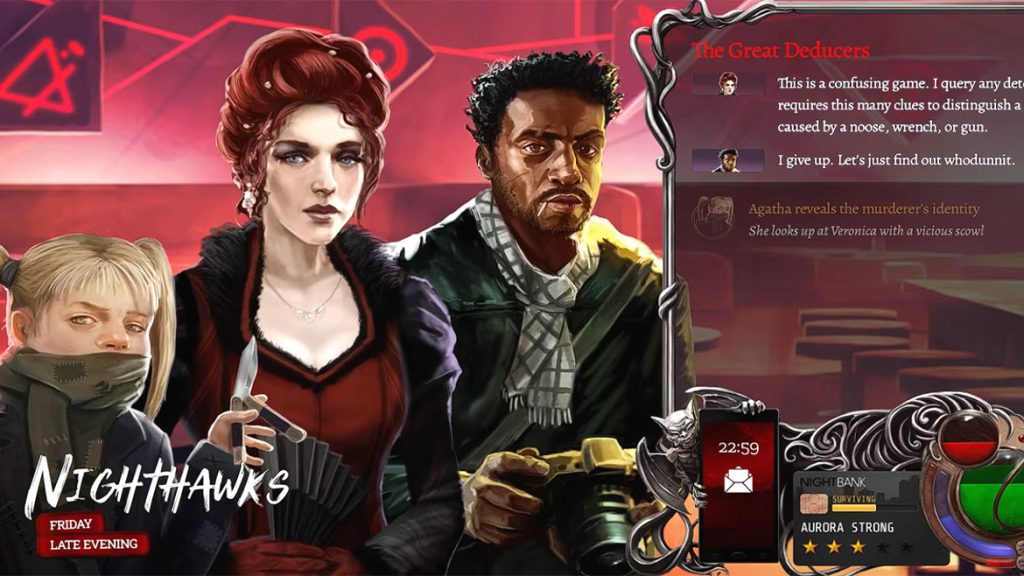
 Into this crowded and rather complicated vampire landscape comes Nighthawks from developer The Curiosity Engine and publisher Wadjet Eye Games. Perhaps the most interesting thing about Nighthawks is that it isn’t officially connected to Vampire: The Masquerade or the World of Darkness at all. Instead, the developers have created an original setting that takes some familiar vampire concepts and approaches them in refreshing new ways.
For example, forget about the Masquerade. In this universe, vampires were exposed to the general public about a decade ago. Everyone knows they exist, and society has been struggling to figure out what to do about that ever since. Humans and vampires don’t exactly get along, but they’re not engaged in open warfare either. Instead, both groups are trying to coexist, sometimes successfully and sometimes not.
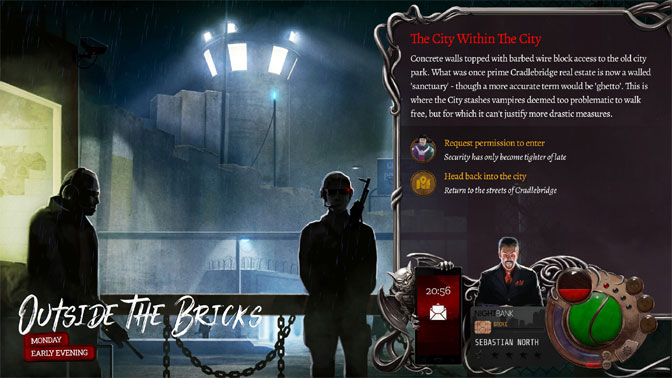 The adventure takes place in the fictional city of Cradlebridge, one of the few places where vampires have been offered something resembling a fresh start. Of course, promising peaceful coexistence and actually achieving it are two very different things, especially when one side occasionally wants to drink the other. This makes Cradlebridge a fascinating place to explore, with uneasy relationships, strange politics, competing interests and plenty of opportunities for a resourceful vampire to make a name for themselves.
Another major departure from VTM is the absence of established vampire clans. At first, I thought I might miss them. After all, one of the pleasures of the World of Darkness is knowing something about a vampire simply by discovering their clan. If someone is a Malkavian, you can expect a little madness mixed with strange insight. If they’re a Ventrue, you’re probably dealing with someone who considers themselves a natural leader and may have several layers of political intrigue already underway. Those familiar identities can be a lot of fun, but they also create expectations.
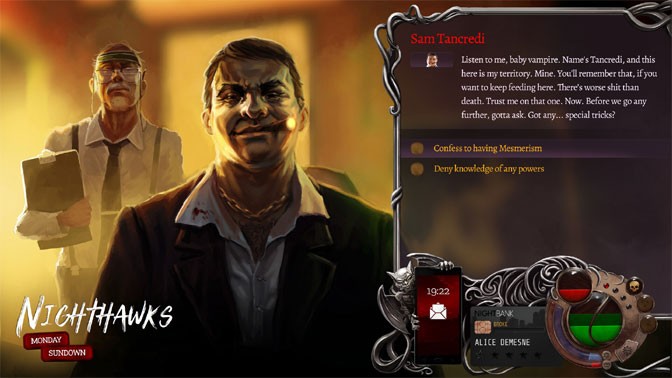 Nighthawks throws those expectations away. Here, vampires are individuals first. They have their own personalities, ambitions, weaknesses and moral outlooks, none of which are determined by membership in a predefined supernatural family. Some are decent people trying to make the best of their unusual existence. Others are manipulative monsters who are perfectly happy to exploit everyone around them.
You also can’t automatically predict what supernatural powers someone possesses simply by knowing their background. I quickly discovered that this freedom makes the characters seem more believable. Instead of feeling like familiar archetypes pulled from central casting, they come across as distinct individuals with complicated lives.
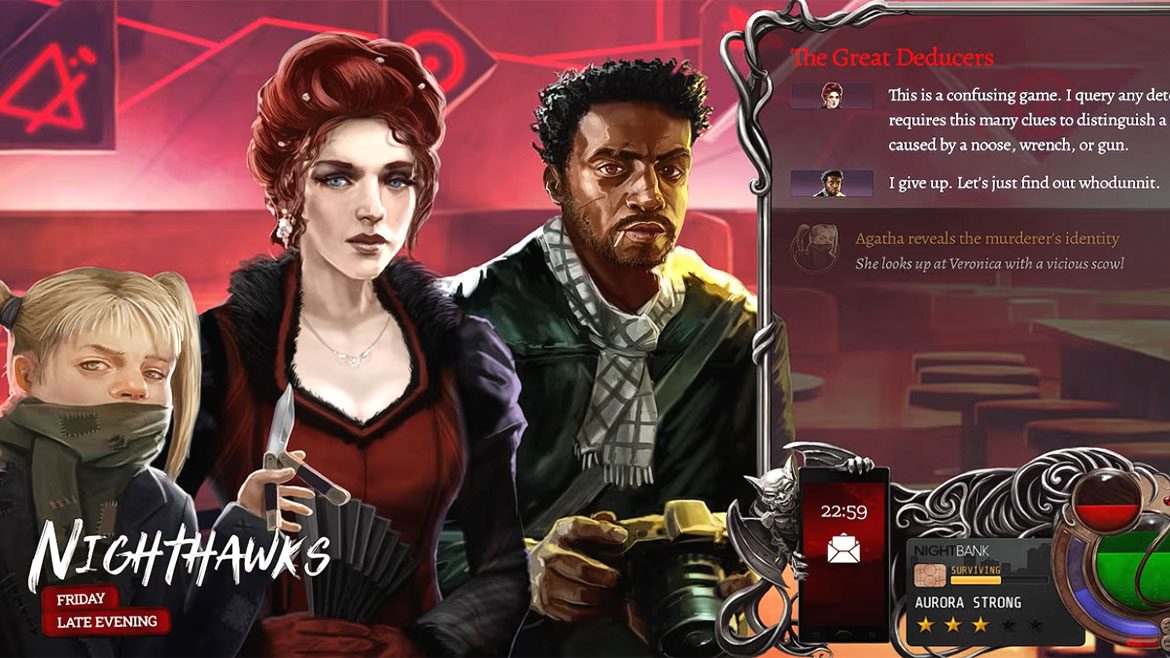
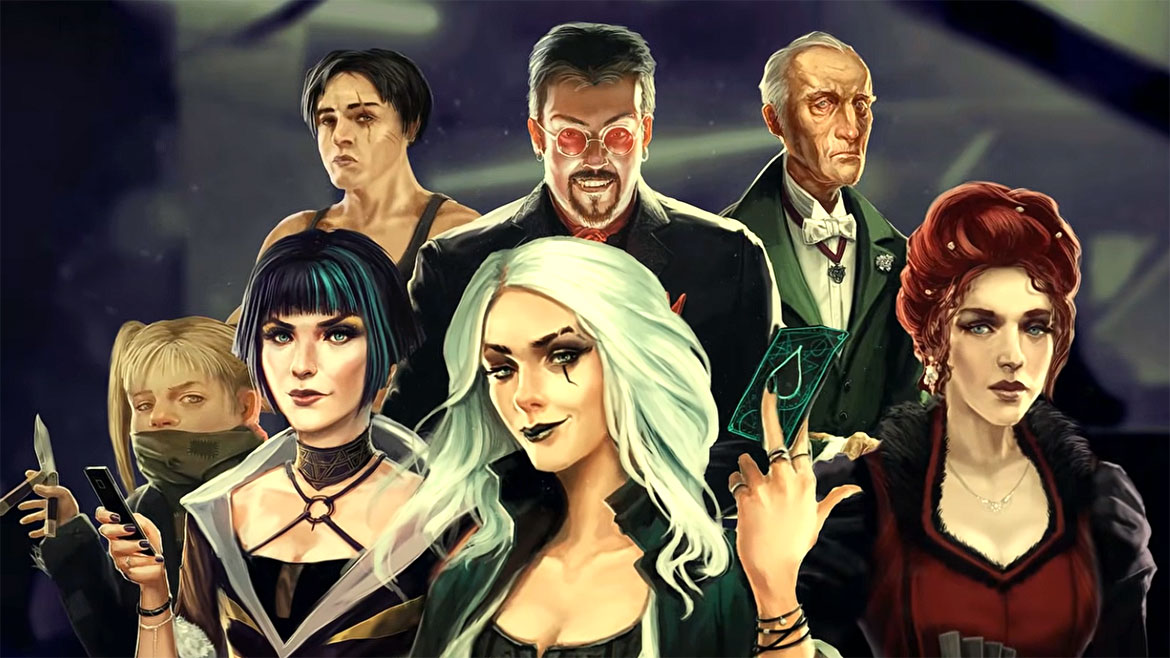
And the characters are absolutely the best part of Nighthawks. There are 10 companions you can potentially recruit, and many of them are so entertaining that I found myself looking forward to conversations with them as much as any major story mission.
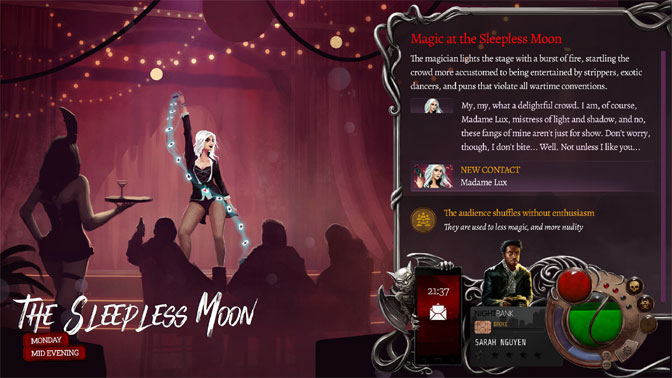 One of my favorites is Madame Lux, a vampire magician with a flair for the dramatic who looks remarkably like Jane Krakowski’s Jenna Maroney character from the television comedy 30 Rock. Once I noticed the resemblance, I couldn’t stop seeing it.
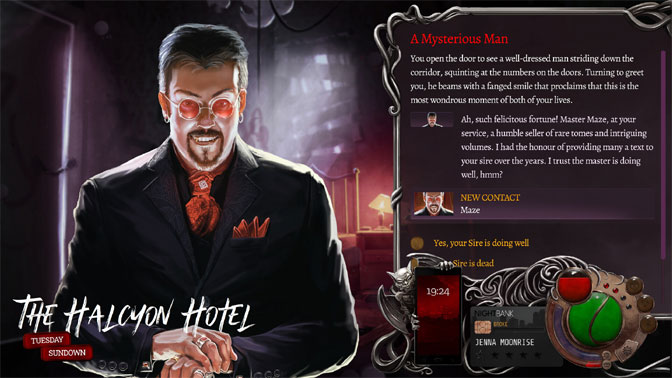
Then there’s Maze, an incorrigible con artist who somehow manages to be charming and irritating at the same time. I kept going back and forth between genuinely liking him and wanting to punch him in the face. That’s actually a compliment to the writing because his personality is so well developed.
Domino is a disgraced private investigator and one of the relatively few humans comfortable spending time around vampires. He brings a more grounded perspective to the group, although his own problems are hardly ordinary.
And then there’s Agatha, a free-spirited girl who was turned into a vampire at a young age and has remained physically trapped in childhood for roughly a century. She has declared herself the Empress of the Rats and can command her furry subjects individually or in enormous swarms. She’s exactly the kind of wonderfully strange character who makes Nighthawks so memorable.
 The supernatural abilities are just as interesting, and players get considerable freedom to decide which ones their own vampire should possess. Instead of choosing a clan and accepting its predefined powers, you can select abilities that fit the character you want to create. Mesmerism allows vampires to exert control over living minds, while Natural Dominion lets them command animals. Other powers are much stranger.
For my first playthrough, I selected Tenebrous Form, which allows my vampire to transform into smoke. I had a wonderful time with that ability, especially because it fit the kind of mysterious, evasive character I wanted to play. Other vampires have their own collections of supernatural gifts, and you won’t necessarily know what they can do until you see those abilities in action. Older vampires are generally more dangerous, something that is also true in a VTM world, having had much longer to develop their skills. You develop yours in the game too over time, getting more uses of your special powers over time.
Your character isn’t completely new to being undead, either. Unlike many vampire RPGs that begin immediately after your transformation, Nighthawks gives you a little history. You’ve already spent time traveling with your sire, the vampire responsible for turning you. Unfortunately, that relationship has fallen apart, leaving you alone and searching for answers. Your initial objective involves locating a former thrall associated with your sire, but that relatively straightforward investigation quickly pulls you into the complicated politics and mysteries of Cradlebridge.
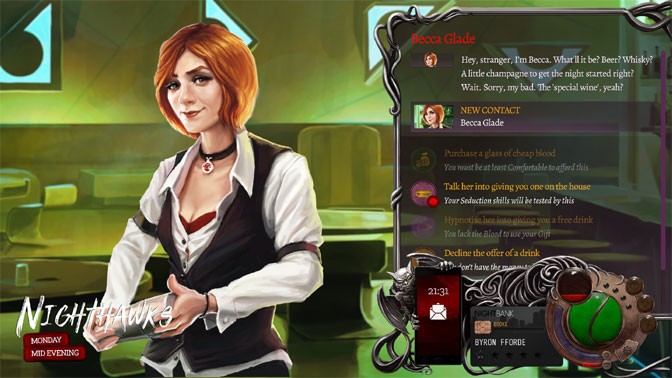 Before long, you’ll also become the owner of a struggling nightclub called Nighthawks, which gives the adventure its name. The club becomes much more than another location on the city map. It’s your headquarters, a place to meet interesting characters, a potential source of income and, perhaps most importantly, a secure haven where you can hide when the sun comes up.
You can improve the nightclub over time, gradually turning a failing establishment into a more successful business. That adds another layer to the adventure because you’re not simply wandering around solving mysteries. You’re also building something that belongs to your character.
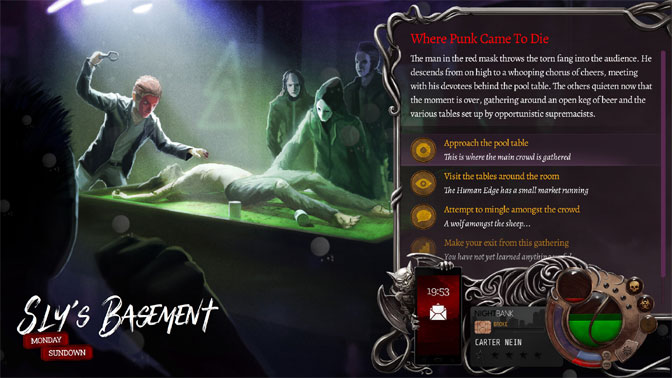
Nighthawks is presented primarily as a visual novel, with illustrated scenes, extensive dialogue and a large amount of descriptive text. However, calling it a visual novel doesn’t really capture how much freedom players have. Most of the time, you’re free to move around Cradlebridge using a city map, selecting places to visit, people to meet and activities to pursue. You might spend an evening investigating a mystery, talking with a potential companion, improving your nightclub or simply looking for opportunities to earn money.
There are deadlines associated with the story, but I rarely found them overly restrictive. Some objectives give you days or even weeks to accomplish your goals, leaving plenty of time to pursue optional activities.
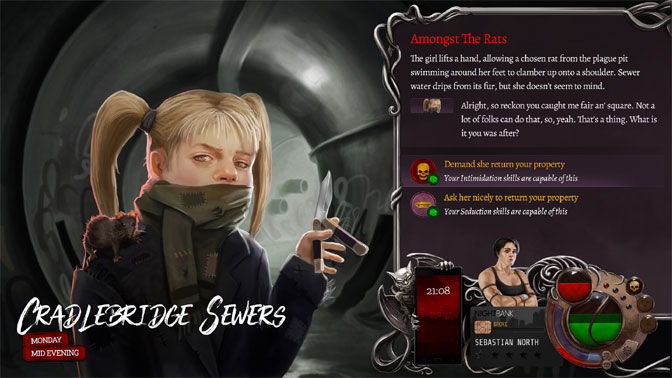 The more immediate limitation is the nightly clock. Because you’re a vampire, you can only safely explore the city after dark. Traveling between locations consumes time, as do conversations and other activities. A phone displayed onscreen helps track the hours, making it relatively easy to plan your evening and return to your haven before sunrise. I really liked this mechanic because it encourages players to think about how they spend their time without creating excessive pressure. You can’t do absolutely everything in a single evening, but you generally have enough freedom to pursue whatever interests you most.
The money system is another example of the developers finding an elegant way to simplify a traditional RPG mechanic without sacrificing depth. Instead of tracking every dollar your character earns and spends, Nighthawks uses a series of wealth levels. Successfully completing jobs, making deals or improving your business can raise your financial standing, which is represented by a meter on your onscreen credit card.
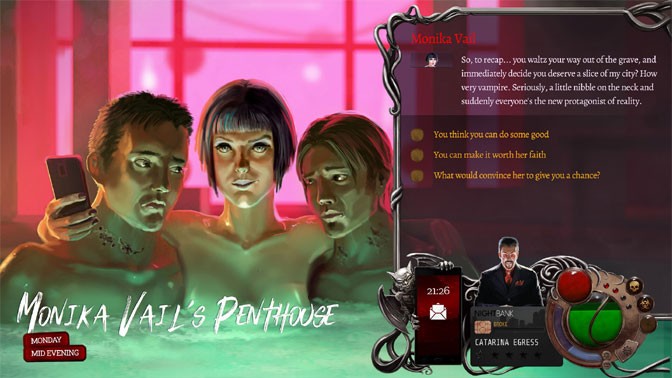 As your wealth increases, you move through categories such as Broke, Comfortable and Affluent. Items require certain wealth levels before you can acquire them. For example, a nice jacket that improves your character’s abilities might be available once you reach Comfortable status, while a more impressive tuxedo could require becoming Affluent. Once you meet the requirement, you can obtain the item without having to calculate a precise purchase price or worry about maintaining a constantly changing inventory of cash. It’s a clever system that lets players enjoy the benefits of becoming wealthy without turning the adventure into an accounting exercise. And there are plenty of reasons to improve your financial situation, from acquiring useful equipment to supporting the nightclub as it grows.
Most activities in Nighthawks involve interacting with other characters, investigating mysteries, uncovering hidden motives and using your abilities to influence the outcome. Traditional RPG skills are still important too. Depending on the situation, lockpicking, mechanical knowledge or other talents might help you overcome an obstacle or discover information that would otherwise remain hidden. You can also find opportunities to train and improve those skills, gradually shaping your character into the kind of vampire you want to become.
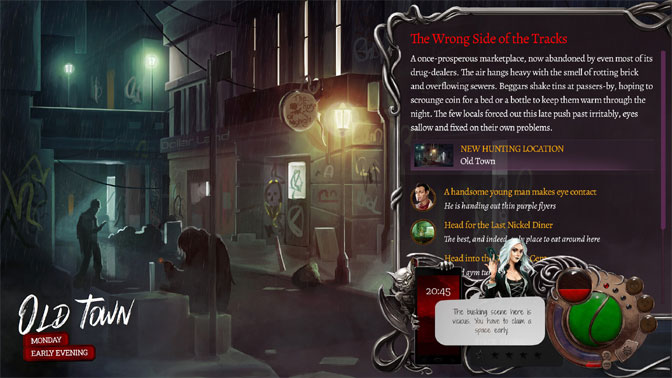 Combat exists, although it is handled differently from a conventional action RPG. When a fight is about to begin, the game evaluates the situation and tells you whether you or your opponent appears to have the advantage. Your character’s combat skills, equipped weapons and any companions accompanying you all influence the outcome. You might improve your chances with a firearm, baton or another piece of equipment, but your character’s abilities and the people fighting alongside you can be just as important.
The actual fight is then resolved through a series of calculations behind the scenes, with the results presented through the game’s narrative interface. This means you don’t personally aim weapons, dodge attacks or execute complicated combat combinations. Instead, success depends largely on your preparation, character development and decisions. I thought this was a good approach for a story-driven RPG. It keeps the focus on role-playing while ensuring that violence remains a meaningful part of the experience.
 There are also consequences to using your powers and getting into fights. Vampires can recover stamina relatively quickly by resting, but replenishing lost blood requires feeding. You can hunt for victims or obtain blood through other means, including a nightly drink available at your nightclub. However, that free supply usually isn’t enough to sustain you indefinitely, so managing your hunger remains an important part of surviving in Cradlebridge.
All these systems work together remarkably well. The nightly time limit encourages planning, the wealth system rewards successful ventures, the nightclub provides a home base and the character interactions give players plenty of reasons to keep exploring.
But what really makes Nighthawks special is the quality of its writing.
The adventure was written and designed by Richard Cobbett, whose previous credits include Sunless Sea and Sunless Skies. The artwork comes from Ben Chandler, with music by Thomas Regin and production by Wadjet Eye Games’ Dave Gilbert. It’s an impressive creative team, and the result reflects their experience with narrative-driven adventures.
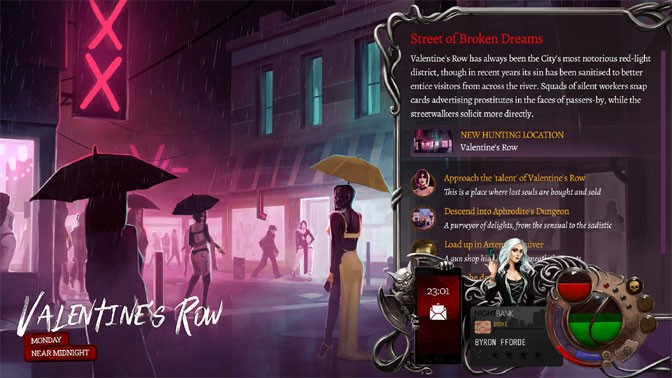
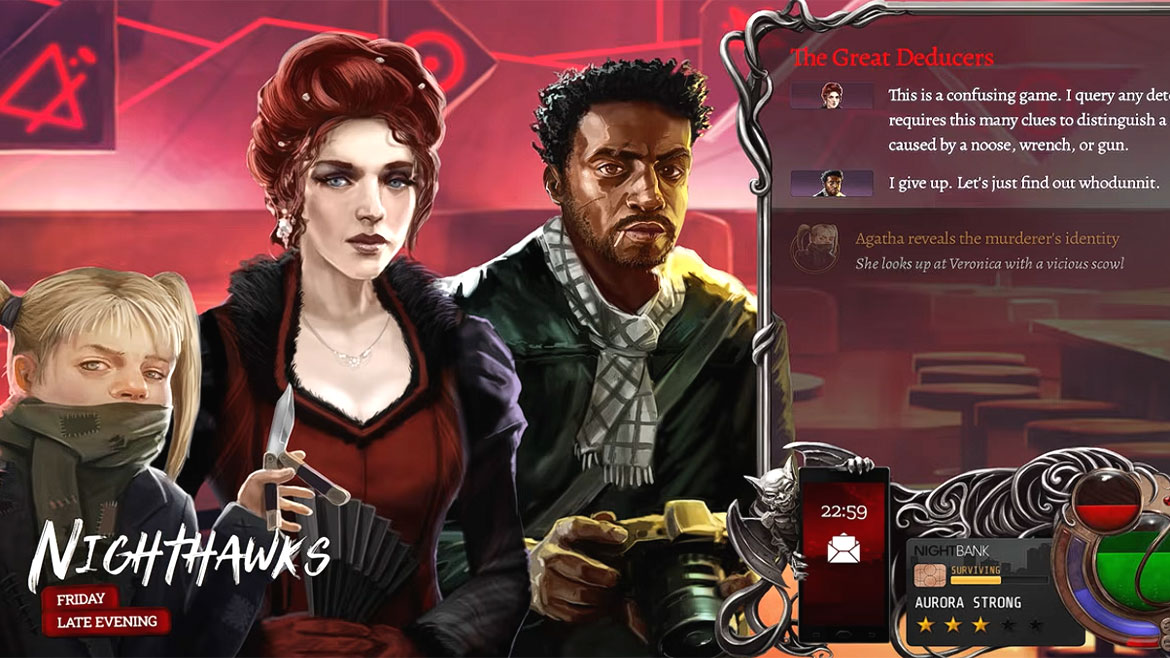 The illustrated environments and character portraits are beautifully rendered, giving Cradlebridge a distinctive atmosphere. The voice acting adds even more personality to the cast, helping make conversations feel lively and memorable rather than simply presenting another screen full of text. And the music complements the moody setting without overwhelming the storytelling. Together, the presentation and writing make this one of the most engrossing visual novel RPGs I’ve encountered.
And despite having a central storyline, Nighthawks frequently gives players multiple ways to approach situations. Your abilities, companions, relationships and personal decisions can influence how events unfold. That freedom also creates tremendous replay value. My first vampire was built around Tenebrous Form, sneaking and even seduction, with a relatively independent approach to life, or perhaps unlife, in Cradlebridge. But I can already imagine playing again with a very different collection of powers and a completely different attitude toward the people around me.
Nighthawks also handles moral choices with considerably more nuance than simply deciding whether to be good or evil. You’re a vampire trying to survive in a society that knows what you are, and that creates plenty of difficult situations where doing the right thing isn’t always obvious. That’s exactly the kind of role-playing I think many players, myself included, really enjoy.
 I went into Nighthawks expecting a good vampire adventure, but I didn’t anticipate enjoying it quite this much. In many ways, it delivers the kind of experience I had hoped to find in Bloodlines 2, even though the two titles approach their subject matter very differently.
It doesn’t have the official World of Darkness license, established clans or familiar supernatural politics. But after spending time with its wonderful cast of characters and exploring the strange streets of Cradlebridge, I don’t think it needs any of those things as it builds its own unique world.
Nighthawks earns my highest recommendation and a perfect 5 out of 5 GiN Gems. It’s an outstanding example of how powerful storytelling, memorable characters and smart role-playing systems can come together to create an adventure that’s far greater than the sum of its parts.
After all, becoming an immortal creature of the night should open up a world of possibilities. Nighthawks is one of the few vampire RPGs that truly makes it feel that way.