
Author: Eric Bergmann
Arcade destruction racers promise players spectacular vehicle damage that accumulates collision after collision. The technical challenge is allowing a car to be smashed to pulp without dropping the frame rate or ruining handling.
In TRAIL OUT — an indie racer with over 100,000 copies sold across PC, Xbox, and PlayStation 5 — damage is built on a combination of morph targets, vertex deformation, and rigid bodies for detachable parts.
Below is a step-by-step breakdown: how deformation works, its limitations, and what had to be tweaked when porting to Xbox.
“The main goal is keeping gameplay stable while everything on screen is breaking and flying apart,” notes Johann Hirsch, Game Director and founder of Good Boys, as well as an Epic MegaGrant recipient.
Step 1. Two Layers of Deformation
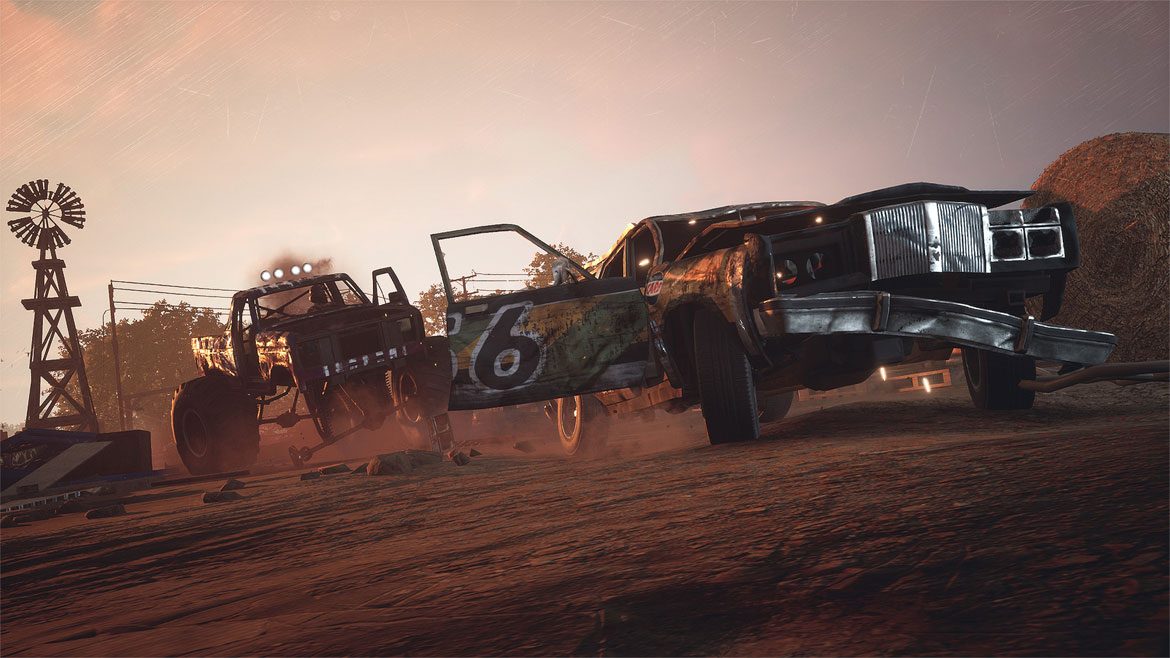
Major body damage — a crumpled hood, a caved-in roof, a buckled trunk — is handled via morph targets. These are pre-made mesh states that the engine interpolates between upon impact. The result is predictable, but limited by the number of presets: the more morph targets a model has, the more damage variations the player sees.
The second layer is vertex deformation, which handles minor damage: 15-30 cm dents that appear right at the point of impact. Every collision looks different, making identical crashes virtually non-existent. This requires no additional assets, as the mesh itself deforms.
Both layers operate simultaneously. Morph targets set the general silhouette of the wrecked car, while vertex deformation adds random fine details on top.
Step 2. Detachable Parts
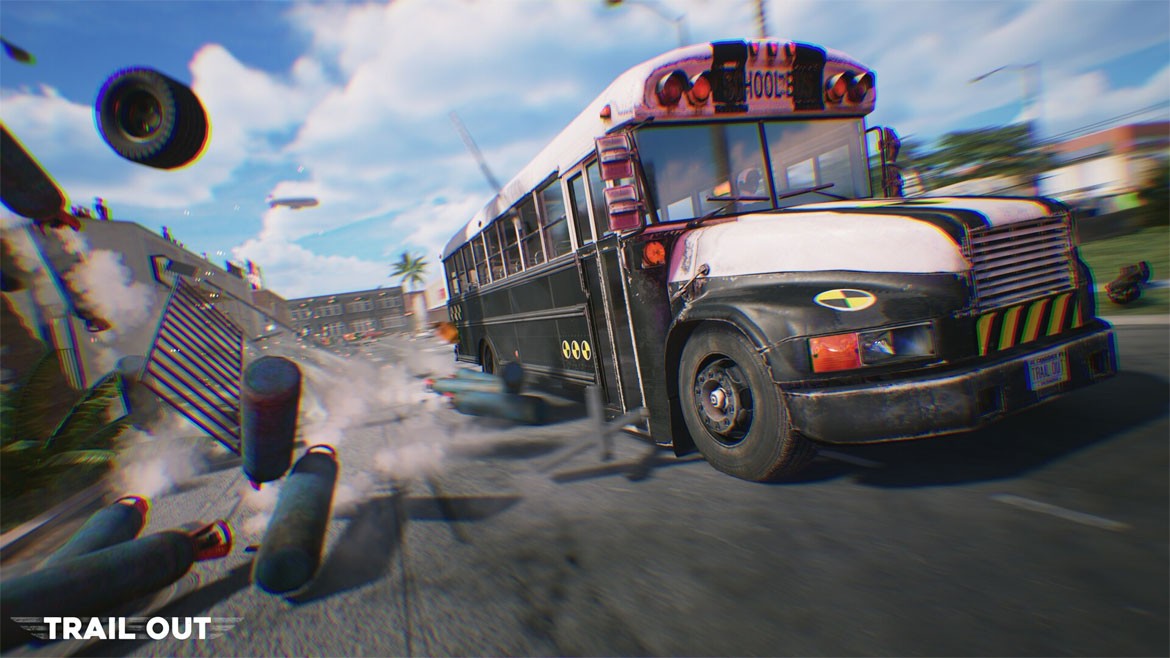
Bumpers, fenders, doors — anything that can rip off — are attached using physical constraints and function as separate rigid bodies. The part first loosens from impacts, then the constraint breaks, letting the part detach and become an independent physics object with its own mass, velocity, and collision.
Up to 300 such objects can exist on scene at the same time. Wheels also run on full collision physics, because in this genre, a wheel detachment means it rolls down the track — a visual placeholder simply won’t cut it.
The main performance load comes from the combination of elements: body debris, ragdolls, wheels, and large environmental props all stress the physics engine at once.
Step 3. A Stable Collision Mesh Underneath a Shattered Shell
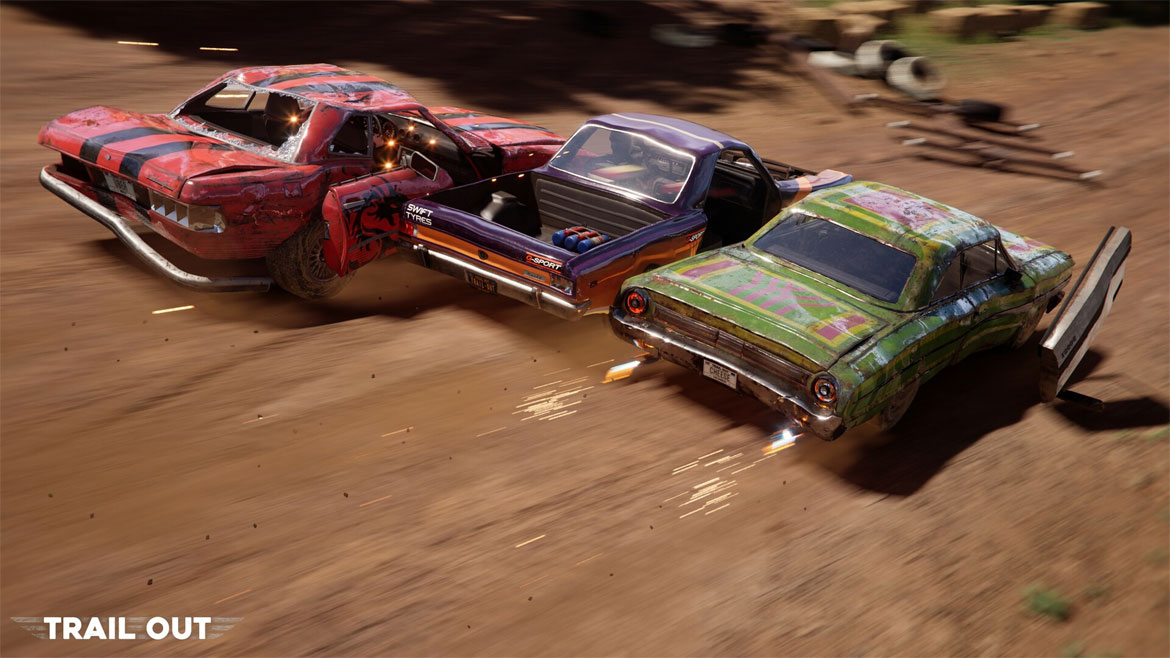
Visually, a car can turn into a heap of twisted metal. However, the collision mesh — which the engine uses to compute impacts and driving physics — remains stable. The player continues the race.
This is a conscious design choice favoring arcade playability. Gameplay consequences do exist: losing a wheel degrades handling, and a damaged engine reduces top speed. But the visual and gameplay damage models run in parallel: a car can look completely dead while remaining fully drivable.
For developers, this setup is convenient because visual fidelity can be dialed up without disrupting race balance.
Step 4. Porting to Consoles
Hirsch personally ported the Xbox version, a process that took about a year. On the Xbox Series S, the number of simultaneously simulated objects had to be cut roughly in half. Physics tick rate was reduced, primarily for ragdolls.
Large maps were split into streaming sectors to avoid loading entire levels into memory at once. Resolution, shadows, and draw distance were also scaled back. The core destruction system itself remained untouched: deformation, detaching parts, and vertex damage were all preserved intact.
“The main challenges involved controls and the user interface. The game was originally designed for mouse and keyboard, whereas consoles have vastly different input and certification requirements,” explains Hirsch, whose work was recognized at DevGAMM 2022 and the Unreal Engine Developer Contest 2020.
Step 5. Certification
Certification hurdles were not related to performance. The main feedback concerned controls: gamepad logic, button behavior, and menu navigation.
Because the game was designed for PC, console inputs required adaptation. The final Xbox version launched without mechanical compromises: everything present on PC made it to console.
Key Takeaways for Your Project
Three principles applicable beyond this specific genre:
- Separate visual damage from gameplay collision. The visible mesh can deform endlessly as long as movement physics relies on a separate, stable collision mesh. This gives artists creative freedom without breaking gameplay balance.
- Limit active physics objects on scene. Every piece of debris requires per-frame calculations. On weaker hardware, it is better to cap the debris count than to disable the destruction system entirely.
- Use vertex deformation for variety. A 15-30 cm dent radius makes every collision feel unique. It is cheaper than crafting extra morph targets and far more convincing than looping animations.
Hirsch predicts growing demand for destructive physics in arcade genres. Over the past decade, major releases in the destruction racing segment have been rare. With over 100,000 copies sold, TRAIL OUT proves there is a clear audience for these games.