

Fishing is one of the strangest success stories in game design. The actual activity involves long periods of waiting punctuated by brief moments of action, which is close to the opposite of what most game designers try to engineer. And yet fishing has become one of the most consistently recurring themes in gaming, showing up on arcade cabinets, console generations going back to the Atari 2600, PC simulation games, mobile titles, indie breakout hits, and now across the online slot catalog.
The theme keeps coming back because the underlying design patterns adapt well to very different game formats.
This piece looks at how fishing has shown up as a design theme across the main platforms and categories. It covers what each era got right about translating the activity into a game format, and why the theme has proved so portable across different kinds of games over the past four decades.
Fishing in Arcade and Early Console Gaming
 Fishing games on consoles go back further than most players realize. Activision’s Fishing Derby, released on the Atari 2600 in 1980, was one of the earliest sports titles on the platform and used a simple side-view format where two players competed to catch the most fish from a dock. The game worked because it compressed the pattern-recognition and timing elements of fishing into a short-session arcade loop, which turned out to be a template that later fishing games would return to repeatedly.
Sega’s arcade entry, Sega Bass Fishing, launched in 1997 with a dedicated rod-shaped controller cabinet and brought the realism arms race into the fishing category. The game went on to receive a Dreamcast port and spawn sequels, and the physical rod controller became a reference point for later fishing peripherals on home consoles. The arcade format kept fishing accessible to casual players who would never buy a dedicated fishing simulator but enjoyed the format in short bursts between other arcade games.
The Fishing Simulator Era
The late 1990s and early 2000s saw a proliferation of fishing simulators on PlayStation, Dreamcast, and PC. Natsume’s Reel Fishing series, launched on PlayStation in 1996, built out a long-running simulation franchise with sequels running across PS2, Dreamcast, PSP, and PS Vita. Rapala’s branded fishing games arrived on consoles in the mid-2000s with licensing tie-ins to the real-world fishing tackle brand, bringing recognizable gear and bass-tournament structure to the console format.
The simulator era established the dedicated fishing-game audience that would carry the category forward. Serious fishing simulations arrived in the 2010s on PC with free-to-play business models, with Fishing Planet and Russian Fishing 4 among the most successful.
These titles treat fishing as a technical hobby. They model authentic gear mechanics, water conditions, and per-species behavior patterns, which is the opposite of the arcade approach but worked well for a different player base.
Casual Fishing on Mobile and Indie Platforms
 Mobile and indie development opened the fishing theme to much broader audiences. Flick Fishing arrived on iPhone in 2008 and used touch and tilt controls to translate the casting motion into a mobile-native interaction, which worked well for casual sessions and sold strongly across the early iPhone era.
the Mobygames fishing games database catalogs over 300 titles across platforms stretching from the Fishing Derby era through to the present. The pattern that emerges is that fishing games tend to cluster at the two ends of the design spectrum: short-session casual formats and deep technical simulators, with relatively little in between.
Mintrocket’s Dave the Diver, released in 2023, became an indie breakout that fused fishing with restaurant-management gameplay and found a crossover audience that extended far beyond the traditional fishing-game demographic. The success of Dave the Diver demonstrated that the fishing theme still had room to be reinvented by combining it with adjacent genres, and the design pattern of pairing fishing with another activity has since been picked up by other indie studios.
Fishing in Slot Design
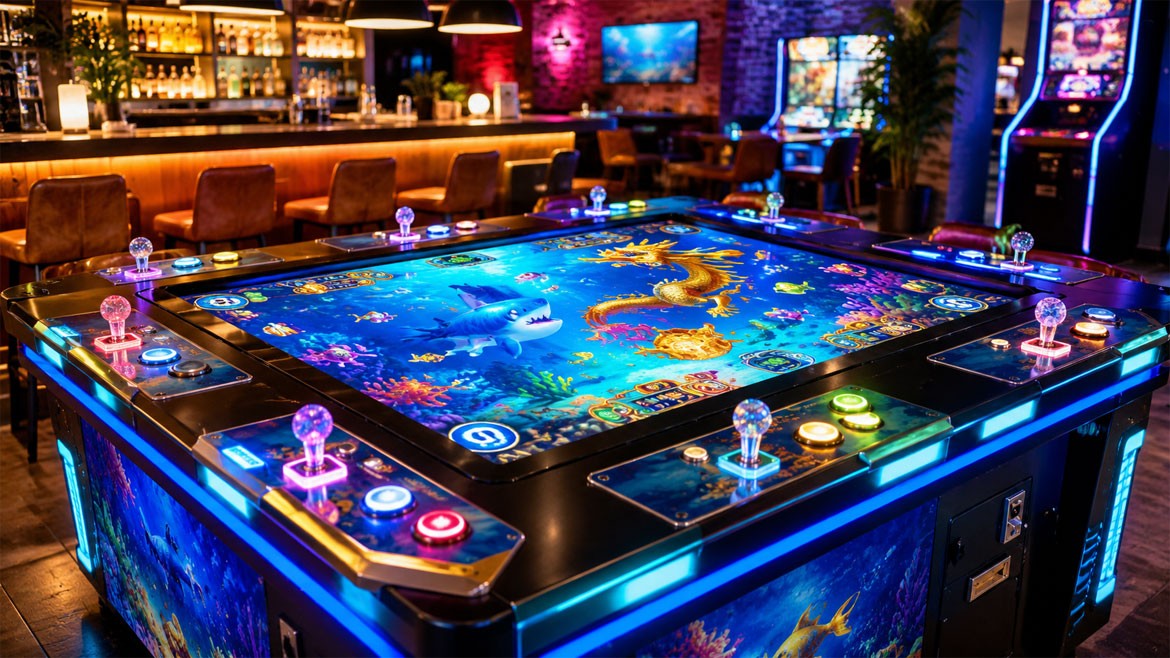
The fishing theme moved into online slot design in parallel with its growth across other game categories. Fishin’ Frenzy, originally created by Australian studio Reel Time Gaming and brought online by UK developer Blueprint Gaming in 2014, has become one of the most recognizable UK slot franchises.
The series has spawned over a dozen sequels and variants under Blueprint’s publishing, including the Megaways version in 2019 and The Big Catch in 2021. The slot format compresses the fishing theme down to its pattern-recognition and anticipation elements, which turns out to adapt well to the short-session structure of slot gameplay.
Fishin Frenzy at Fruity King sits in that long tradition of fishing games adapting to new platforms. Blueprint Gaming’s title runs on the UK operator’s catalog alongside the broader franchise lineup.
The design DNA traces back through Blueprint’s 2014 release to Reel Time Gaming’s original brick-and-mortar slot cabinet, and from there to the arcade and console fishing games that established the theme’s appeal. The slot format is the latest iteration rather than a departure from the pattern.
Why the Theme Keeps Working
Fishing games across four decades
1980 Fishing Derby released on Atari 2600 by Activision; two-player side-view competitive fishing
1996 Reel Fishing debuts on PlayStation by Natsume; starts a long-running simulator franchise
1997 Sega Bass Fishing arrives in arcades with a dedicated rod-shaped controller cabinet
2000s Rapala-branded fishing games bring licensed bass-tournament structure to consoles
2008 Flick Fishing on iPhone translates casting into touch and tilt controls
2014 Fishin’ Frenzy brought online by Blueprint Gaming after its land-based slot debut
2010s Fishing Planet and Russian Fishing 4 establish free-to-play fishing simulators on PC
2019 Fishin’ Frenzy Megaways launches, catapulting the franchise into mainstream UK slot catalogs
2023 Dave the Diver fuses fishing with restaurant management; indie breakout hit
Looking across forty-plus years of fishing games, a few patterns show up consistently. The theme adapts well to short-session formats because the underlying activity has a natural rhythm of waiting and action that maps onto arcade, mobile, and slot pacing structures.
It adapts well to simulation formats because the real-world activity has enough technical depth to support dedicated hobbyist engagement. And it adapts well to indie reinvention because the activity carries enough cultural weight that pairing it with other genres produces interesting results, as Dave the Diver demonstrated.
What makes fishing unusually portable as a design theme is that the activity itself is already structured in a way that games can borrow from directly. The anticipation, the pattern recognition, the moment of resolution, and the varying difficulty across different fish species all map onto standard game design concepts without needing much translation.
That structural fit is why fishing shows up on new platforms as they emerge, and why it is likely to keep showing up in whatever game formats arrive next.