
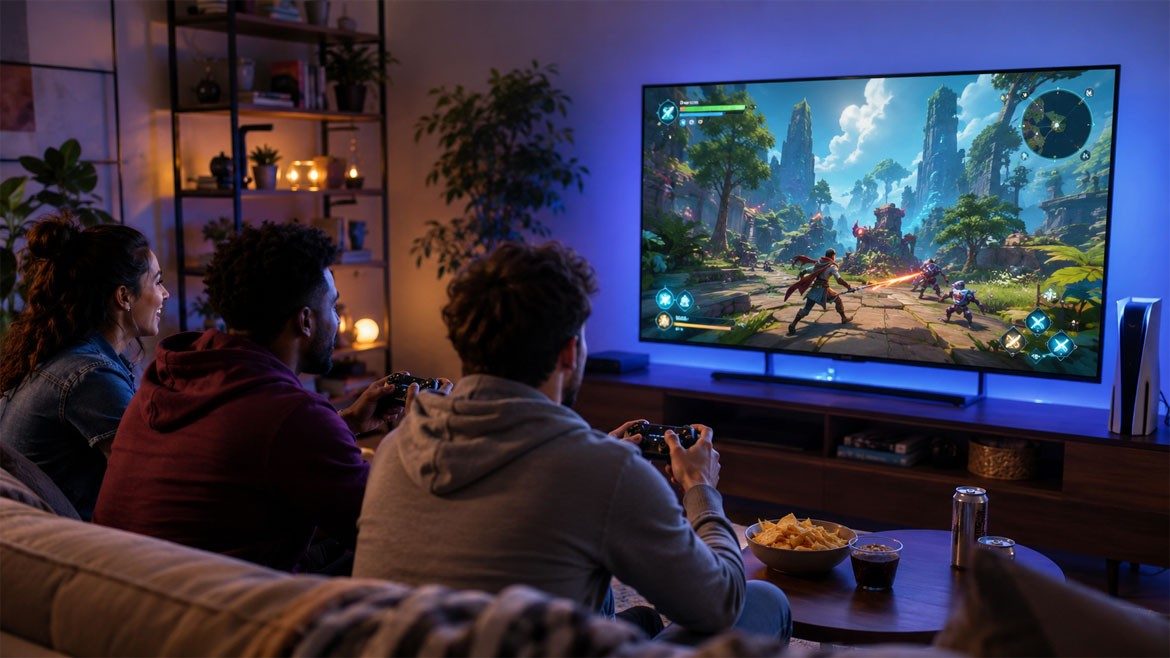
The next console cycle is starting to reveal itself before any new PlayStation or Xbox has reached store shelves. Sony brought Quick Spectral Super Resolution, or QSSR, to the standard PS5 on October 1; Nintendo Switch 2 already pushes up to 4K at 60 fps or 120 fps at 1080p and 1440p; and Microsoft has confirmed a custom AMD SoC and FSR Next for Project Helix, with developer alpha hardware planned for 2027. None of those moves look isolated anymore. Machine-learning reconstruction, heavier ray tracing, high-refresh displays, portable hardware, and game libraries that follow the player are steadily becoming the new baseline.
Native 4K Is Losing Its Monopoly
Native 4K remains useful, but brute-force native rendering is no longer the only route to a sharp image. PS5 Pro launched with 67% more GPU compute units than the original PS5 and 28% faster memory, yet Sony also made PlayStation Spectral Super Resolution one of the machine’s defining features; by February 27, 2026, Sony said PSSR had boosted effective resolution in more than 50 titles. QSSR pushes the same reconstruction strategy onto the standard PS5 with a lighter neural network, and Marvel’s Wolverine and Ghost of Yōtei were the first two games patched to use it on October 1.
Ray Tracing Gets a Real Frame Budget
 PS5 Pro also shows where ray tracing is headed. Sony says its upgraded hardware can cast rays at roughly twice, and sometimes three times, the speed of the original PS5, while Remedy’s CONTROL Resonant offers a PS5 Pro Quality mode targeting 30 fps at 2160p with ray tracing and a Balanced mode targeting 40 fps at 2160p with ray tracing on a 120Hz display. Microsoft is making an even larger claim for Project Helix, describing an order-of-magnitude increase in ray-tracing performance and capability, though that remains a manufacturer target until shipping games provide measured results.
GameChat Turns the Console Into a Second-Screen Hub
Nintendo has made the console itself part of the communication layer. GameChat on Switch 2 supports voice sessions for up to 12 people, while no more than four participants can share video or game screens at the same time. That same multi-screen behavior fits esports viewing, where a live match, statistics, and chat can stay open together; a viewer checking map or match odds on Mel Bet is comparing prices whose implied probabilities include the bookmaker’s margin. A fixed bankroll and stake size keep those live selections consistent when odds move after a round, objective, or scoring event.
Forty Frames Per Second Finds Its Screen
Forty frames per second has become a practical display target rather than an odd middle ground. On a 120Hz panel, every 40 fps frame occupies three refresh cycles, which produces even cadence and a 25-millisecond frame time; CONTROL Resonant uses exactly that arrangement for its PS5 Pro Balanced mode. Nintendo Switch 2 supports 120 fps output at 1080p and 1440p, and system version 23.0.0, released September 9, 2026, in North America, added VRR support in TV mode when the game, display, and dock setup support it. The dock also needs an update before TV-mode VRR can be enabled.
Microsoft Wants Your Games to Outlive the Box
 Microsoft’s hardware strategy now treats portability and continuity as one system problem. The company said in March 2026 that Xbox Play Anywhere had grown beyond 1,500 games, while the ROG Xbox Ally and Ally X had already launched on October 16, 2025 with an Xbox full-screen experience on Windows 11; Project Helix is being designed to play both Xbox console and PC games. A sports fan can keep a game or stream on one screen while checking form, live data, and a market inside MelBet online betting on another, with the quoted odds changing as the score, clock, and match state change. Stake size still comes back to the same arithmetic: compare the price with an estimated probability, then keep the amount within a preset bankroll. Any promotion attached to the bet should be checked against its current wagering terms and settlement rules before it affects the stake.
Old Libraries Are Becoming New-Hardware Requirements
Backward compatibility is becoming part of hardware planning rather than a late software feature. Microsoft says it intends to keep games from four generations of Xbox playable for years to come, while Nintendo Switch 2 supports compatible physical and digital Switch games, although Nintendo warns that some titles remain unsupported or only partly compatible. Nintendo’s Virtual Game Cards also let a digital title move between two linked systems and be lent to a Nintendo Account family member for up to 14 days, subject to the service’s pairing and lending rules. For the next hardware cycle, compatibility lists, save transfer, and digital-license rules may tell buyers as much about a console’s useful life as its peak teraflop count.