
One esports game pulled 5,680,304 people onto the same stream at the same moment in January 2026. It was not League of Legends, and it was not Counter-Strike. It was Mobile Legends: Bang Bang, whose M7 World Championship grand final became the most-watched esports broadcast of the cycle. Ask the question slightly differently, and you get a different winner: League of Legends still leads on hours watched, the metric that tracks how long an audience stays rather than how many turn up for one match. This ranking of the top esports games orders 2025 and 2026 tournament data by peak concurrent viewership, and publishes watch time next to every entry so you can see both answers.
How Esports Viewership Is Measured (and Why the Rankings Disagree)
Three numbers get thrown around as if they mean the same thing. Peak concurrent viewers counts the single highest moment of a broadcast, usually a grand final map five. Hours watched multiplies audience by time across an event or a season, which rewards long league formats. Average viewers sits between them and is the fairest measure of a circuit’s week-to-week health.
The trackers most of the industry cites are Esports Charts, Stream Hatchet and Gamesight. This list ranks by peak concurrent viewers recorded during the 2026 competitive calendar to date, with 2025 full-year watch time and event-level figures attached to each game. That window matters: Worlds 2026 has not happened yet, so League of Legends is judged here on MSI and its regional leagues rather than on the October spike that will reorder this chart again.
One caveat runs through everything below. Western trackers measure Twitch, YouTube and Kick. Chinese platforms like Huya, Douyin and Bilibili sit outside that net, so every figure attached to a Tencent title is a floor rather than a full count.
1. Mobile Legends: Bang Bang
Genre: mobile MOBA. Publisher: Moonton.
The M7 World Championship in January 2026 peaked at 5,680,304 concurrent viewers during Aurora Gaming PH’s 4-0 demolition of Alter Ego in the grand final, the largest audience any mobile esports event has assembled and the fourth-biggest esports broadcast on record.
What makes MLBB the most interesting entry is that its league play is nearly as strong as its world championship. MPL Indonesia Season 15 peaked at 4,132,224 viewers and generated 113,297,084 hours watched, the fourth consecutive Indonesian split to clear 100 million hours. No other non-global championship in esports history has reached that peak tier.
The reasons are structural. Southeast Asian audiences watch on the same phones they play on, matches run in local prime time rather than European afternoons, and the free-to-play install base in Indonesia and the Philippines is enormous. MLBB was also the most-watched title at the Esports World Cup 2026, generating 45.27 million hours in Paris. In these numbers, mobile esports is the ceiling.
2. Counter-Strike 2
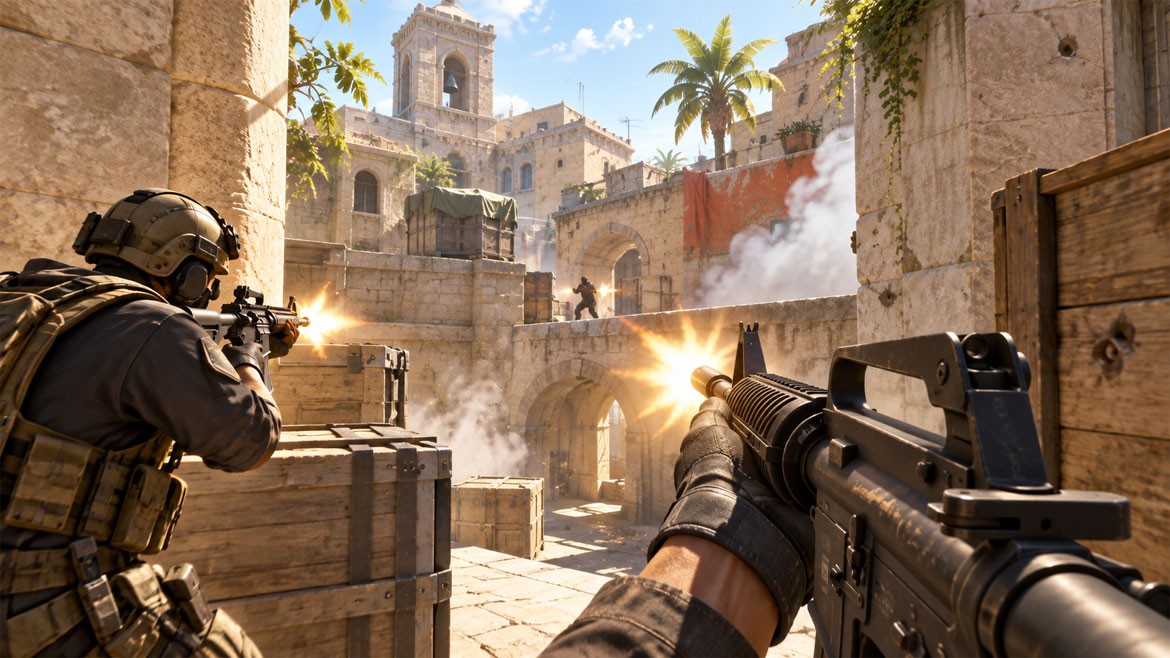 Genre: tactical first-person shooter. Developer: Valve.
CS2 is the rare esports title whose audience curve points up. It was the only game in the 2025 top five to grow its hours watched year over year, posting a gain of more than 33% to 584.7 million hours, and it carried that momentum straight into 2026.
The IEM Cologne Major 2026 is the proof. The FURIA versus Team Falcons grand final peaked at 2,752,353 viewers, breaking the previous Counter-Strike record set by PGL Major Stockholm 2021 at roughly 2.75 million. Across nearly 160 hours of broadcast, the Major averaged 627,863 concurrent viewers and banked 100.30 million hours on its own.
Money follows. Counter-Strike has distributed $20,985,148 across the 2026 calendar, more than any other esport, and it is the only ecosystem where a publisher circuit and an independent one genuinely coexist: Valve’s Majors anchor the year while BLAST, ESL and the IEM tour fill the other ten months. The messy CS:GO to CS2 transition cost the scene momentum in 2023. Three years on, the shooter is the healthiest competitive property in the industry.
3. League of Legends
Genre: MOBA. Developer: Riot Games.
Judged on peak viewers inside the 2026 window, League of Legends sits third at 2,315,920, set by T1 versus G2 Esports in the MSI 2026 lower bracket. Judged on watch time, nothing touches it. Riot’s 5v5 flagship, two teams of five fighting over one map, generated 735.5 million hours across 2025, roughly 150 million more than Counter-Strike.
The 2025 World Championship peaked at 6,752,585 viewers and produced 136.4 million hours watched. The LCK 2025 season produced 161.8 million. A Korean domestic league out-watched the world championship because Riot consolidated Korea’s year into one continuous season instead of two splits and kept an audience locked in for months. Weekly league play, not the one big final, is where watch time accumulates.
That franchised structure is also the pipeline back into the game itself. Every deep Worlds run sends a wave of lapsed players to ranked, and a slice of them skip the level-30 unlock grind by picking up a ranked-ready League account rather than starting from zero.
4. Dota 2
 Genre: MOBA. Developer: Valve.
The International 2026 ran from 13 to 23 August at the Shanghai Oriental Sports Center, peaked at 1,796,267 viewers, averaged 590,963 across 109 broadcast hours, and finished with 64,513,364 hours watched. Team Spirit beat PVISION 3-2 for $1,429,894.
Those are strong numbers, and they are a reduced version of what Dota 2 used to do. The audience has contracted while the prestige has not. TI’s crowdfunded pool once hit $40 million in 2021 before Valve reworked the Battle Pass model; TI 2026 stood at $3,355,417 at the time of the event. Yet across the full 2026 calendar, Dota 2 has still distributed $12,837,500, second only to Counter-Strike, because the Esports World Cup and the third-party circuit now carry money the Battle Pass used to.
This is the cleanest example of the gap between prize-money rankings and viewership rankings. Dota 2 sits fourth here and first on the all-time earnings table. Those two facts have nothing to do with each other, and any ranking that treats prize pools as a popularity proxy is selling you a bad map.
5. PUBG Mobile and PUBG: Battlegrounds
Genre: battle royale. Developers: Krafton and Tencent’s Lightspeed studio.
The PUBG Mobile World Cup 2026 peaked at 1,791,774 viewers, the game’s second most popular tournament ever and its biggest since 2021, up roughly 28% on PMWC 2025. The PC version, PUBG: Battlegrounds, peaked at 808,543 in the same window. One franchise, two circuits, and the mobile side wins comfortably.
Geography explains it. PUBG Mobile’s center of gravity runs through India, Pakistan, Bangladesh, Indonesia, and the Gulf, markets where a phone is the primary gaming device and the fight to be the last one standing needs no explanation to a new viewer. Hindi-language broadcasts of PMWC 2026 grew their hours watched by 247.8% year over year, and Turkish peak viewers rose 249.1%. Battlegrounds Mobile India, the country-specific build, peaked at 728,713 on its own.
The PC global series still draws a committed Korean and Chinese audience, but the gap is no longer close. When people say the battle royale genre is fading, they are describing a Western Twitch chart, not the sport.
6. VALORANT
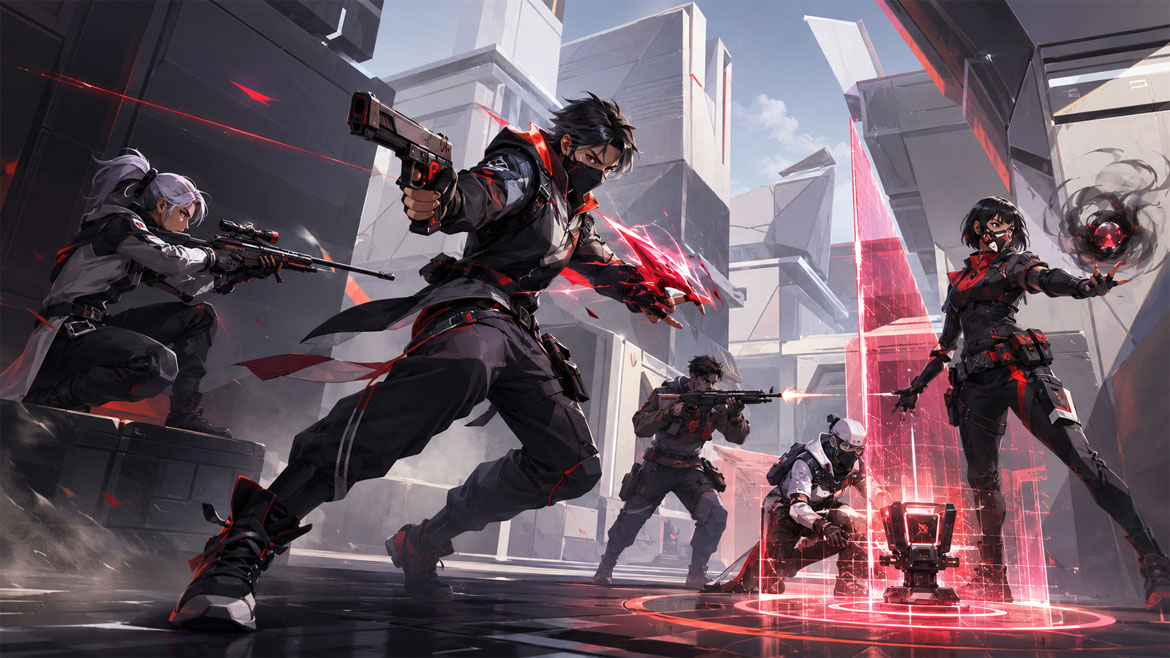 Genre: tactical shooter. Developer: Riot Games.
VALORANT’s 2026 peak sits at 1,071,916, down from the 1,473,652 that Champions 2025 recorded when NRG upset Fnatic 3-2 in the grand final. Across 2025, the game accumulated 328.6 million hours watched, fourth among all esports titles and remarkable for a shooter that launched in 2020.
The hook has always been the hybrid: precise Counter-Strike gunplay welded to agents with unique abilities, rewarding aim and strategy in the same round. It also gives casters something to narrate beyond crosshair placement.
The Valorant Champions Tour’s international leagues have done the heavy lifting, and the Pacific leg is the growth engine. Masters Bangkok 2025 is instructive: Esports Charts logged a grand final peak of 1,307,646, while Riot’s own count, including Chinese platforms, reported over 4.3 million. Champions 2025 also set a YouTube record with 679,414 concurrent viewers. The gap between those two credible numbers for the same match runs to three million viewers, and it comes down to what each one counts.
7. Free Fire
Genre: mobile battle royale. Publisher: Garena.
Free Fire peaked at 804,934 viewers in 2026, ahead of every Western PC title outside the top six. The Free Fire World Series SEA 2026 Spring set a regional record at 598,673 peak viewers, and FFWS Brazil 2026 Split 1 hit 201,057, its best since 2024.
Garena built Free Fire for low-spec Android hardware and ten-minute matches, which is exactly why it thrives where 100-player lobbies and 4GB downloads do not. Its two strongholds, Southeast Asia and Brazil, are also two of the loudest esports audiences anywhere. The game held the all-time mobile esports viewership record, set at the 2021 World Series in Singapore, until MLBB took it this January.
One consequence of that reach is a large secondary economy around progression, with marketplaces like igitems listing Free Fire accounts alongside currency and top-ups for players who would rather inherit a loaded roster than rebuild one. Free Fire rarely appears on Western top-ten lists. On the numbers, leaving it out is indefensible.
8. Honor of Kings and Arena of Valor
Genre: mobile MOBA. Publisher: Tencent, with Garena handling parts of the regional release.
Honor of Kings peaked at 777,965 viewers in 2026, and Arena of Valor, its international sibling, at 773,481. At face value, that makes the world’s highest-grossing mobile game a mid-table esport. In context, it makes the trackers look short-sighted.
The King Pro League lives on Huya, Douyu, Bilibili, and CC163. Those platforms do not publish concurrent viewers. They publish a heat index, a weighted engagement score that cannot be converted into a Twitch-style figure without guessing. So when a Western tracker logs a KPL final, it is logging the overseas simulcast and nothing else.
The money says what the viewership charts cannot. Honor of Kings has distributed $7,849,385 across 2026, more than League of Legends, and its World Cup at the Esports World Cup 2026 carried a $3,025,000 pool. Arena of Valor sits fifth on the all-time esports earnings table at roughly $111.5 million, ahead of titles that get ten times the Western coverage. This is the largest esports audience nobody in the West can measure properly.
9. Rocket League
 Genre: vehicular sports. Developer: Psyonix.
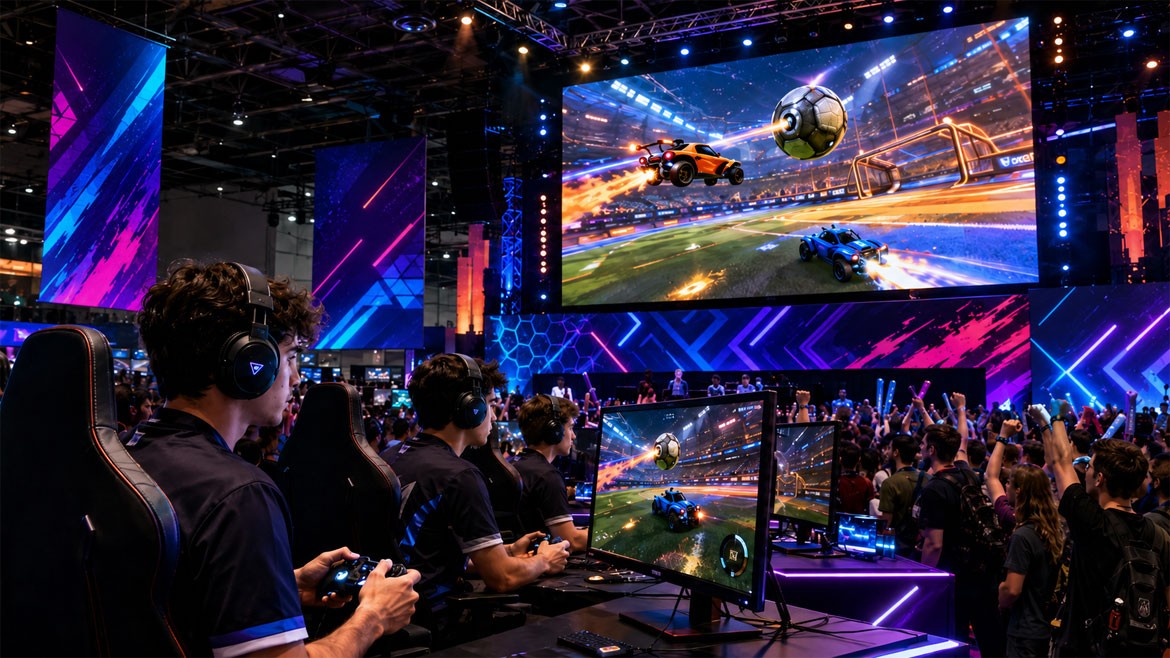
The RLCS 2026 Boston Major in February peaked at 624,316 viewers, the first time Rocket League esports cleared half a million, with Gentle Mates taking the title. For context, the RLCS 2025 Birmingham Major peaked at 287,987 for a $351,000 pool. That is a jump of more than 115% for a game plenty of people had written off.
Two things drove it. Psyonix leaned into a co-casting ecosystem built around creators rather than fighting it, and viewership rewards gave casual fans a reason to leave the stream open. The rest is game design. Car football is legible in a way nothing else on this list is: no item builds, no ability cooldowns, no economy round. Two nets, five minutes, aerials that demand real team coordination, and a scoreboard your grandmother could read. In a competitive gaming world that usually asks for 200 hours of context first, that is an asset.
10. Fortnite
Genre: battle royale. Developer: Epic Games.
Fortnite peaked at 605,548 viewers in 2026, and the FNCS 2026 Major 1 European grand finals topped out at 243,203. For a game with millions of players, that is a startling conversion rate, and it is the most instructive number on this list.
Epic Games has distributed more than $209 million in prize money across its competitive history, second only to Dota 2, including the $3 million solo payout at the 2019 World Cup that made a teenager rich and made every parent aware of esports. FNCS 2026 carries over $10 million in prizing and closes with the Global Championship in Antwerp on 26 and 27 September.
So why does a player base that size not convert into sustained watch time? Because competitive Fortnite and casual Fortnite are different products. Placement points are hard to follow, 100-player lobbies have no clean narrative, and the game’s PC and console audience mostly wants to play with friends rather than watch professionals build. Epic’s creator ecosystem out-draws its esports broadcasts on any given weekend.
Just Outside the Top 10: Call of Duty, Apex, Rainbow Six and the Fighting Games
Four scenes missed the cut, and the honest numbers are more useful than a padded list.
Call of Duty had its best competitive year on record. The CDL 2026 Stage 4 Major in Nanterre peaked at 379,533 viewers, the most-watched Call of Duty esports event ever, helped by the league’s return to Twitch and a genuinely international schedule. The first-person shooter’s structural problem has not