
The Elder Scrolls IV: Oblivion was the very first Elder Scrolls title I ever played. In 2006, I built my first ever computer using components I picked out myself with money from my very first job, and the very first game to be installed on my machine was one of the finest open world experiences before we even knew to call them “open world.” This was also my first try at a first-person RPG that wasn’t a dungeon crawler like Wizardry, so going from games with the scope of Fire Emblem: Path of Radiance, or Resident Evil 4 to Oblivion was absolutely mind blowing.
You can read all about that heady time in my recent Save State column. Now, on to the review.
 Oblivion is a game that starts off in a manner that would be considered commonplace now. You pick your race and design your character, finding yourself locked in a prison, taunted by a criminal behind bars. It starts off simply enough- you pick your race and design your character, though the visuals of the game made it pretty easy to make a horrific, blue eldritch abomination that would only be known throughout the land as Dingleberry. You soon encounter the emperor of the country of Tamriel, Uriel Septim, who despite finding you in a prison cell believes meeting you to be fate because he’s seen your face in his dreams (with how I designed characters, likely nightmares too).
Uriel Septim is attempting to flee assassins who have already claimed the lives of his sons, and due to the emperor’s immediate affinity for you, you’re given free rein to escape- should you be able to survive the catacombs and sewers. This leads into a tutorial that shows you how to engage in melee combat, sneak around, and several other useful game mechanics. Unfortunately, even with your assistance, the emperor is killed and you’re given the task of venturing through the sewers to deliver an important amulet to Septim’s illegitimate heir (else all of Tamriel be damned to ruin by invaders from a hellish plane of existence). The start of the adventure is enough of an impetus to get you going, but that’s not what made Oblivion special.
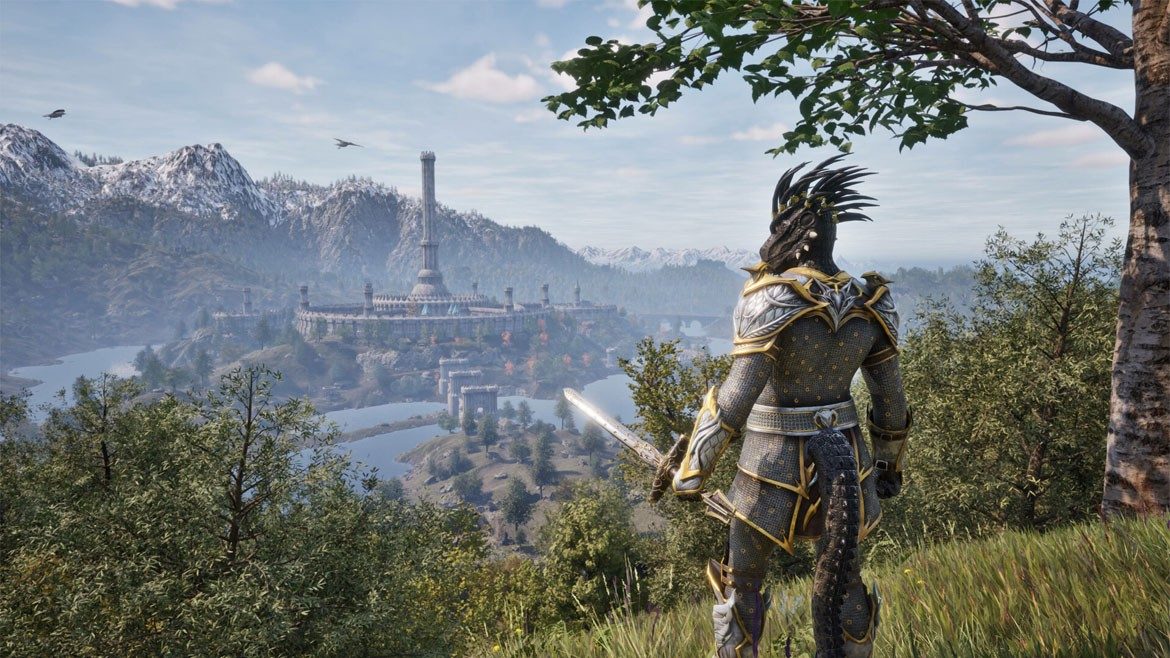
You’re given a lot of options as you progress through the tutorial, as you can pick from a bunch of different pre-made classes, but players can even customize their own, giving you the chance to specialize exactly how you’d like your character to be. After making your way through the sewers, you’re given one last chance to edit your character’s appearance, race, and class, and then you’re sent out into the world of Cyrodiil. Back in 2006, coming out of the sewers and seeing just how large Cyrodiil is was astounding, though expectations are much more tempered twenty years later since so many other games have created expansive open worlds. Still, for its time, Cyrodiil holds up extremely well, allowing the player to venture across the land and encounter all sorts of characters, creatures, and quests.
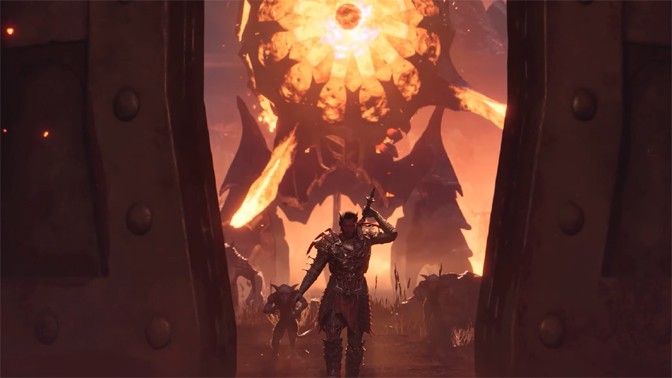 Your earliest quests show you that otherworldly invaders from the plane of Oblivion are making their way into Tamriel due to the emperor’s death, and you’re among the few capable of crossing into those portals, defeating the beasts that lie on the other side, and closing those gates for good. Effectively, there are large, fiery instance dungeons that will pop up all over the map, giving you great chances at exploration and loot as you progress through the title and level up. When it comes to playing Oblivion, if you’ve experienced other Elder Scrolls games, much of this one should be very familiar to you.
You can even try to avoid the main quest if you want, as our other reviewer did when he reviewed the remastered game for the Steam platform for the PC, which is pretty amazing and really speaks to how well the open world is crafted.
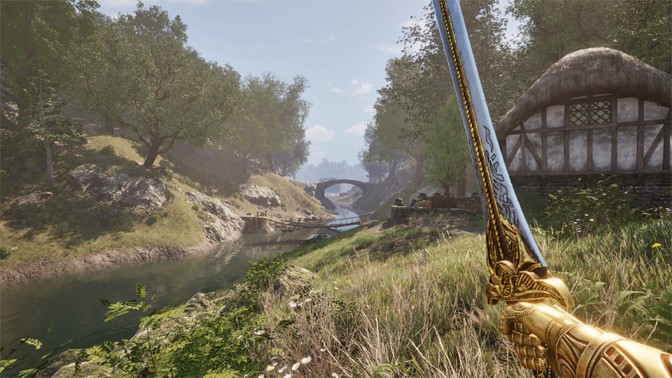
You can play Oblivion in first or third person, and can use a variety of different weapons such as longswords, axes, bows, as well as extremely powerful magic you can customize yourself. You can equip shields and go for a sword-and-board play style, you can use bows and daggers to sneak up on enemies and take them out while they’re unawares, or you can go full Ainz Ooal Gown spell caster and stack loads of buffs while unleashing explosions that can wipe out an entire city. The choice is yours, but Oblivion really lends itself to a spellsword kind of approach as magic is very good in this.
Quest-wise, you’ll find a wide variety of wacky characters in your journey to aid the emperor’s heir, as you’ll encounter obsessive fans, an alchemist concerned with the punishment for necromancy, and a guy who tries to do image training but winds up locking himself in his own dream. It was remarkable to see just how well the world of Cyrodiil and its NPCs held up even after twenty years because I can’t imagine many, or any, of their voice lines were really touched. The mid-2000s were really the wild west when it came to dubbing video games, which just goes to show how ahead of its time Oblivion was when compared to a lot of its contemporaries.
Of course, while questing and exploring are all well and good, how you progress your character matters too. Oblivion Remastered overhauls how characters level up for the better, making the level up system much less restrictive and avoiding common pitfalls that new players would experience. Now, like in Skyrim, all of your skills contribute towards your level ups, and your attributes are no longer tied specifically to the skills your raised to level up, which cuts down on the micromanagement significantly. They also fixed the Endurance attribute scaling so it applies retroactively too, which means you can put your attribute points into Strength, Willpower, or Intellect instead of spamming Endurance for your first many levels. A fun thing Oblivion does is that you can really feel your attribute increases too, as increasing Speed will have an obvious impact on how quickly you move across the map, running faster than many enemies and even horses.
 While leveling was revamped to make more sense, you’re still able to abuse the skills and leveling systems pretty handily if you know what you’re doing. Some players of Oblivion may prefer to nearly maximize their sneak or lockpicking skill in the game’s intro, while others may prefer to raise things naturally as they explore, resolve quests, and find treasures. Enemies and loot you encounter throughout the world are also influenced by your level, so reaching level 25 or higher may result in you seeing fewer weaker creatures and more Daedra, but you also might find extremely valuable items like the Ring of the Sorcerer to finally complete your 100% magic absorb build for infinite spell casting. It’s give and take, but Oblivion Remastered smoothed out this curve considerably so you don’t peak the strength of enemies without improving your own battle capabilities too.
While Morrowind could let you fly and Skyrim lets you loop alchemy and smithing to create the greatest weapons and armor in the universe, Oblivion’s claim to fame is in its magic system, and it’s the one Elder Scrolls title where the “stealth archer” meme shouldn’t apply. After a certain point in the adventure, you can begin crafting your own magic spells, tweaking the damage, duration, and range of your fireballs and even adding on telekinesis effects, charm, and a bunch of other things gated only by your magicka reserves. Experimenting with this system is an absolute ton of fun, though I really, desperately wish there was some way to remove created spells you no longer want from your list of learned magic.
 This version of Oblivion on the Nintendo Switch 2 also supports mouse mode controls, which was predominantly how this review was conducted, though it’s worth mentioning I had to 3D print a grip in order to make a sideways joy con comfortable. In spite of the Joy Con 2’s ergonomics, mouse controls are quite good and accurate, allowing me to aim spells at long range without much issue. There are also gyro controls but, for whatever reason, they only work when aiming a bow. So, if you use a bow, great, but if you’re playing as Dingleberry the Warlock or are someone who hasn’t played a console shooter without gyro controls in many years, all of your ranged spells basically become touch range in order to actually hit their targets.
There is a massive elephant in the room regarding Oblivion Remastered’s performance on the Nintendo Switch 2, though. It’s an elephant large enough that even the most oblivious Khajit couldn’t overlook: The title’s performance ranges on a scale of passable to miserable, oftentimes rapidly fluctuating between the two while navigating in a single area. Loading into the overworld map from an interior environment will, quite often, produce frame rate hitches that are reminiscent of shader caching for a few seconds before shifting to its maximum frame rate of 30fps (though that will dip to 20 or so depending on what else is happening or where you are at the time). The fact that it performs as well as it does when compared to other platforms is still somewhat impressive given its portable nature on the Switch 2, but it’s absolutely understandable that some players would be put off by this.
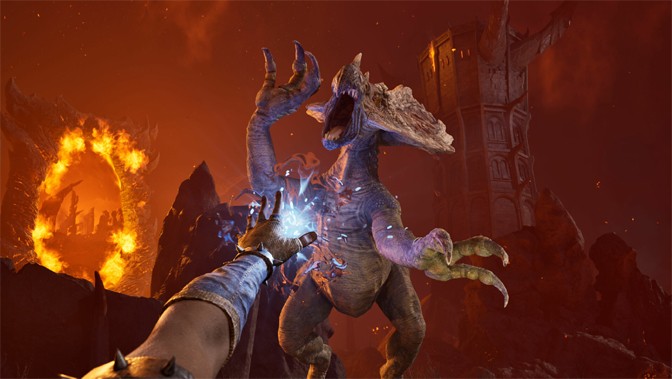 Caves, catacombs, and other small, corridor-like environments allow Oblivion Remastered to really shine in respect to its performance and visuals on the Switch 2. Thankfully, a good portion of Oblivion takes place in smaller locales, and scouting dwemer ruins and the like really drives home the fact that this is a portable version of a monumental fantasy RPG from 20 years ago. The lighting, on the other hand, looks absolutely gorgeous when in dark environments or near one of the many Oblivion Gates you’ll need to close throughout your adventure. While the art style of the game took a hit, the visuals of the Remaster make the 2006 classic look like how I remember my times playing it two decades ago.
Visuals in portable versus docked are fairly consistent- using the Switch 2 in handheld or tabletop shows a slightly softer image compared to docked TV play, but the actual visuals look similar between the two. This isn’t a case of playing handheld suddenly makes all the shadows disappear or something, which has been seen on other, much worse Switch ports previously. The image quality on the Switch 2’s version of Oblivion Remastered is better than expected, being more in line with Xbox Series S likely due to the title’s utilization of DLSS. The reliance on DLSS does create some hazy afterimages of moving characters at a distance or when the game gets busy though.
So, overall, the performance of Oblivion Remastered on Switch 2 is worse in some ways, but much better than expected considering its performance on other platforms. For example, while the PS5 and Xbox versions would have frame rates that noticeably degrade the longer you played, the Switch 2 version is somehow exempt from this behavior. While the game hitches after fast traveling, and you’ll experience inconsistent frame rates while out in the overworld of Cyrodiil, performance in handheld/tabletop mode is considerably better than expected given all of the frame rate issues still present in other versions of the title.
 It is worth mentioning that I had really, really bad crashing issues for a single day, never occurring again for the remainder of my time in Cyrodiil. The first few crashes involved going through a screen transition where the game would be stuck on the loading screen, never actually advancing to where I could play. After that, there were two black screen hangs that required the software be closed and reopened, a full on freeze after fast traveling, and then a final “the software has been closed due to an error” message caused me to turn off my Switch 2 for the night. Strangely, since restarting the system completely, there hasn’t been a single further crash when playing Oblivion Remastered. But it’s definitely worth noting that it crashed a whopping 6 or more times in a single day.
The Elder Scrolls IV: Oblivion has a reputation for being one of the buggiest (oftentimes hilariously so) games that released in the mid-2000s. This remaster was specifically sold as being the Oblivion everyone loved twenty years ago, so a lot of the bugs players could abuse to humorous effect still exist. Many quest-breaking bugs were resolved, but there are still plenty that exist in the remaster that are largely relegated to side quests, but hey, you can always blow them up if a quest giver really upsets you. During my dozens of hours with Oblivion Remastered, I had exactly one side quest break due to loading a quicksave at what was apparently an inopportune time, but otherwise all of the quests I tried worked as intended, which is great.
 Oblivion does have adjustable difficulty settings, though many of the beneficial bugs from the original release still work in this one if you’re wanting to adjust the difficulty more to your liking. If you’re wanting to get more than a handful of the special Hatred Soul bow’s arrows, there are several duplication glitches that still work. There’s also unlimited carry weight and magicka tricks you can use to really experiment with what this game will let you get away with when it comes to backpacking items or calling a lightning bolt the size of the tri-state area.
When it comes to Switch 2 ports, performance is always a concern. Sometimes you get excellent ports like Cyberpunk 2077, Star Wars Outlaws, and Resident Evil Requiem which still run reasonably well with a number of compromises to maintain a reasonable frame rate much of the time. Conversely, you have others like Assassin’s Creed Shadows and Warhammer 40k: Rogue Trader that are so awful you should avoid them on the platform. Elder Scrolls IV: Oblivion Remastered falls in the middle range, stuttering when in Cyrodiil’s overworld similar to Cyberpunk’s Dogtown on the same platform. Considering Oblivion, even at its most crowded, isn’t exactly a fast-paced title, I didn’t find the performance to be that much of a detriment even when being attacked by multiple enemies, but it’s very easy to see how some may not be able to fully enjoy it due to the frame rate drops.
 If you’ve never played Oblivion before, there’s never been a better time, and it is still absolute loads of fun to play- especially on the go. Visually, it looks beautiful, especially in terms of lighting, but Oblivion Remastered for Switch 2 definitely has some technical flaws that will likely impact the enjoyment of those who are sensitive to poor frame stability or don’t have massive amounts of nostalgia for a twenty-year-old title. If you’re sensitive to poor performance, Oblivion on Switch 2 is likely more a 2 out of 5 for you. For those who are able to overlook those performance flaws, Oblivion is a game that was ahead of its time and rewards player ingenuity in many, many ways so it’s fully worth playing again, or for the first time, in 2026.