
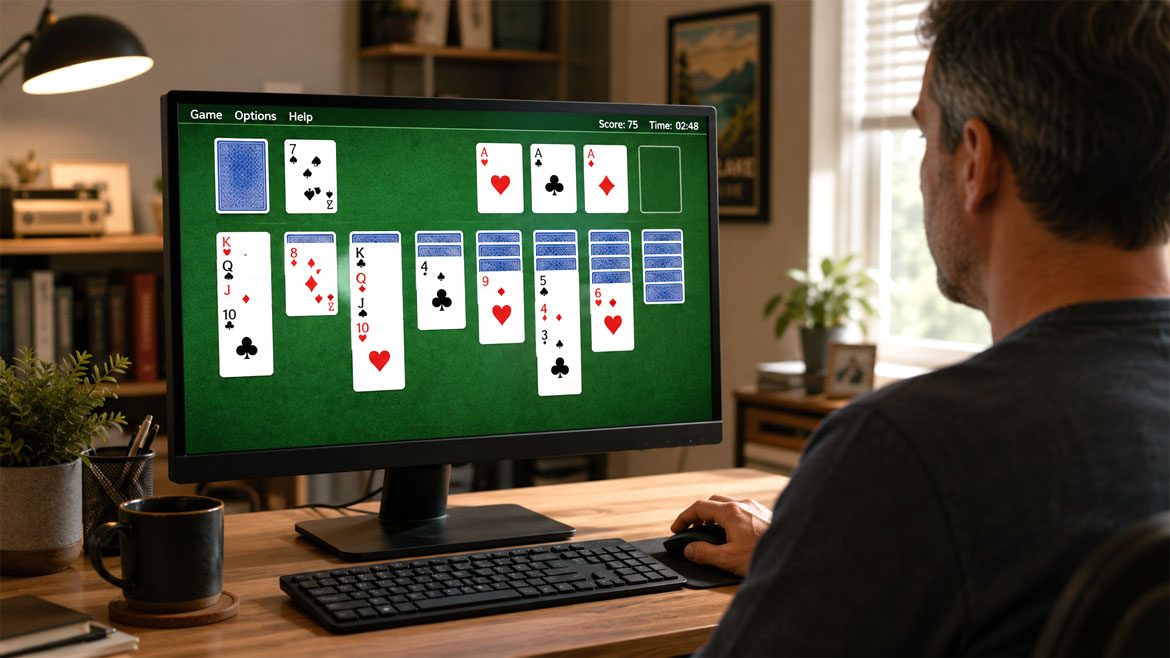
Not every game needs to eat your weekend. Some of the best ones ask for five minutes and give them right back, and in that humble category — the one we lovingly file under “Time Waster” — few entries have aged as gracefully as solitaire. It has outlasted the beige PCs it shipped on, survived the death of Flash, and quietly migrated to the one place that needs no installation at all: the browser. Load up a clean version like Playsolitaire.io and you’re dealing a hand in seconds, with no account, no download, and no patch notes. After more than three decades, the world’s most familiar card game might still be the most perfectly engineered short break in gaming.
That’s a bold claim for a game your grandparent plays, so let’s actually examine it like the time waster it is.
What Makes a Great Time Waster
The genre has rules, even if nobody writes them down. A truly great five-minute game has to thread a specific needle, and most fail at one point or another:
- Instant on, instant off: It needs to start the moment you want it and release you the moment you’re done, with no loading screens, cutscenes, or “are you sure you want to quit?” nagging in between.
- Zero learning curve: You should be able to play competently within seconds, every single time, without relearning controls after a week away.
- Meaningful but low-stakes decisions: There has to be enough thought to occupy your mind, but nothing on the line if you lose. Pressure is the enemy of a real break.
- Naturally bite-sized: A session should resolve in minutes, not stretch into an open-ended commitment that swallows your afternoon.
- No baggage: No mandatory updates, no storage footprint, no login walls between you and the game.
Hold solitaire up against that checklist and it doesn’t just pass — it reads like the game the checklist was written to describe.
How Solitaire Nails the Brief
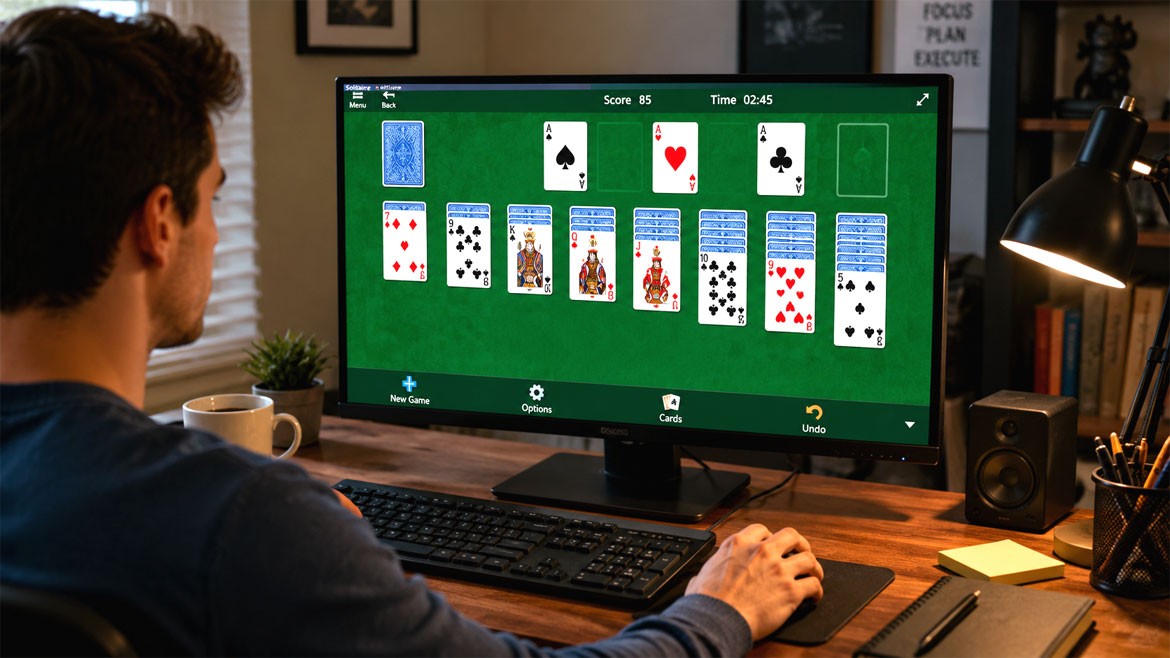 Start with the on-ramp. There is nothing to learn, because you almost certainly already know how to play, and even if you don’t, the rules reveal themselves in a hand or two. Compare that to nearly any modern mobile game, which front-loads a tutorial, a currency system, and three pop-ups asking for notification permissions before you’ve touched the actual game.
Then there’s the session length, which is close to perfect. A hand of Klondike resolves in a handful of minutes. You win, you lose, or you decide it’s unwinnable and deal a fresh one — and at no point are you punished for stopping. The game holds nothing hostage. There’s no energy meter refilling on a timer, no daily streak guilting you into returning, no sense that walking away costs you anything.
And underneath that calm surface, your brain is genuinely engaged. Good play means holding the state of the board in mind, planning a few moves ahead, and weighing whether to commit a card now or wait for something better. It’s light cognitive work, the mental equivalent of a short walk rather than a workout, which is exactly what a break should be. The payoff, when it comes, is that famous cascade of bouncing cards — a little burst of satisfaction that casual games have been imitating ever since.
The Browser Is Its Natural Habitat
For a game that has lived on floppy disks, hard drives, and phones, the browser turns out to be the most fitting home of all. A good browser version asks nothing of your hardware and runs identically on a work laptop, a phone on the bus, or a desktop between tasks. There’s no install to regret, no storage to sacrifice, and nothing to uninstall later. You open a tab, play, and close it.
That accessibility is the whole appeal of the modern time waster. The friction between “I have five minutes” and “I am now playing” has been reduced to essentially zero, which is more than most games with launch trailers can claim.
The Quiet Case for Restraint
Here’s the part worth dwelling on, because it’s where solitaire quietly shames a lot of contemporary design. A clean version of the game has no dark patterns. It isn’t trying to maximize your “time on device” or convert your boredom into a purchase. It doesn’t interrupt a winning streak with a video ad or dangle a limited-time offer the moment you lose. It simply lets you play as much as you want, then hands you back to your day.
In an era where so much of the industry is engineered around engagement metrics and monetization funnels, a game that’s content to just be a game feels almost radical. The best time wasters respect your time precisely because they don’t try to steal more of it than you offered. Solitaire has been doing that since before “engagement” became a boardroom obsession, and it’s still the gold standard.
The Verdict
As a time waster, browser solitaire is close to flawless. It loads instantly, demands nothing, occupies your mind just enough, and never overstays its welcome. It won’t top a game-of-the-year list, and it isn’t trying to — but for the specific job of filling five honest minutes and leaving you a little calmer than it found you, nothing has improved on it in over thirty years. Some classics endure because they’re nostalgic. This one endures because it’s still, quietly, the best at what it does.