
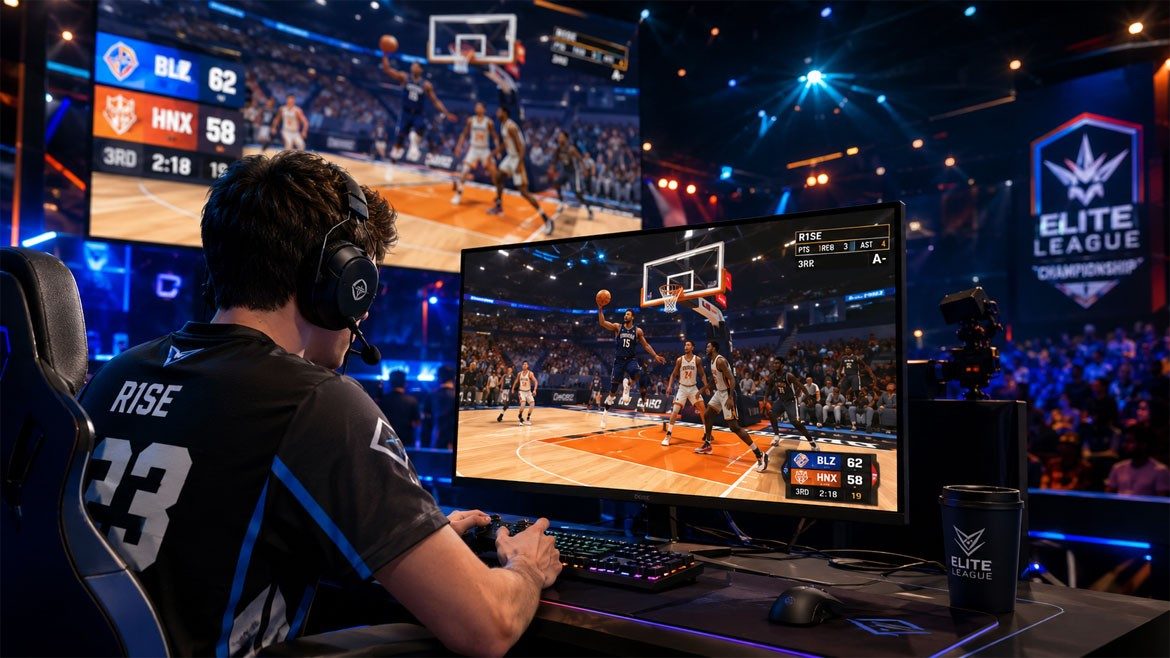
The owners and operators of NBA 2K League, NBA Take-Two Media, announced a major change late last year with how it would be run. The focus would shift from gameplay exclusively to highlighting entertainment and online content as well.
Taken at face value, the announcement came across as vague, if not vapid. Generalities have a way of sounding profound without effectively illustrating what the change will look like. Even more so, the announcement did not coincide with a major shift in how the league operates. We did not see teams shudder operations. There was no reinvention of the schedule. All of the best online sportsbooks with NBA 2K League lines spotlighted by MyTopSportsbook.net still offered the same odds. The franchise itself did not even undergo any material changes to its gameplay. The usual amount of new features accompanied NBA 2K 26; nothing more.
Months later, though, we have now seen what NBA 2K League looks like in action. And the difference is real.
NBA 2K League has Become a Personality-Driven Operation
Launched in 2017, NBA 2K League is backed by the NBA itself. The National Basketball Players Association is now a partner as well. This agreement was struck in an attempt to bring real-life players into the center of the league.
On top of that, and perhaps notably, NBA 2K League has started working with popular content creators, such as Jess “Jesser” Riedel, who boasts 35 million subscribers on YouTube. The idea behind these strategic partnerships with the NBPA and influences was to create social-first content. Essentially, NBA 2K League wants to increase its traction across platforms like YouTube, Instagram, X (formerly Twitter), TikTok, etc.
Recognizable creators like Jesser with loyal followings draw in eyeballs, which leads to more engagement. But the league did not stop there. After all, there is a difference between one-off and fleeting engagement, and recurring interactions. With the goal of catering to the latter, NBA 2K League started running special competition windows, and above all, began providing peaks behind the scenes.
“With the new 2K League, we’re building an entirely new type of entertainment universe that blends competition with content,” CEO of NBA Take-Two Media Andrew Perlmutter said this past November, per Esports Insider. “Filled with wild, wacky, unpredictable and emotionally resonant moments, we’re extending the immensely popular world of NBA2K beyond competitive gaming and will show fans who their favourite athletes and creators are off the court.”
It remains to be seen how much the NBA 2K League has increased its virality in the early aughts of its new era. With that said, they do seem to be taking the initiative seriously. Not only are clips of could-be viral moments available in larger supply, but shortly before this writing, the league announced its Next Fan Up program. Players can sign up for free, and take part in competitions during prescribed windows. The higher they climb up the leaderboard through their victorious gameplay, the more likely they are to win prizes, which range from merchandise to experiences.
Is This the Future for Esports Leagues?
 Naturally, folks around the industry are posing this question in earnest. And to be sure, it does not yet have a definitive answer. If we had to guess, though, this entertainment-, fan-first approach is one that’s going to stick—at least as it pertains to Esports leagues for traditional sports.
Indeed, the NBA 2K League could be an exception. The actual National Basketball Association openly admitted to forming its own social-first league years ago. Commission Adam Silver has acknowledged many fans now follow teams and players through clips on social media rather than through live gameplay. The Association’s All-Star Weekend is also inundated with YouTube and TikTok influencers making appearances, hosting events, participating in the celebrity game and son.
The same cannot be said for leagues like the NFL, MLB, MLS or NHL. So there is a chance the NBA 2K League experience-centric model goes down as an anomaly. Then again, parasocial relationships have become more ubiquitous than ever. Fans want to feel connected to the influencers, content creators and even professional athletes that they follow.
While other sports differ in how much a single player or two can be front-facing and impact the game in real life, esports is always going to be different. One team member or user can make all the difference when playing any video game. There is merit, then, to other Esports leagues flirting with this approach.
Of course, we are not even a year into the NBA 2K League’s new era. More time needs to pass before we expect Madden Leagues to run a reality series, like the NBA 2K League just did. (It was called MyPlayer Mayhem.) At the very least, though, the effectiveness of this approach is worth monitoring. Because if the NBA 2K League finds success with it, we may see a permanent difference in how esports leagues everywhere operate.