
A few years ago, social casino games were easy to place in their own corner of mobile gaming. Their identity was largely built around familiar casino-style mechanics, while casual games were associated with puzzles, matching games and other quick-play formats. That boundary is becoming much less obvious.
Part of the change is visible in how slot-style games are now presented. Someone looking for Vegas slots online may encounter a social casino title like Slotomania that offers far more than a simple spinning mechanic. Many now include themed events, collectible features and progression systems that give players reasons to return in much the same way as other casual mobile games.
The numbers suggest that this is more than a design coincidence. Casual gaming is becoming a larger and more sophisticated part of mobile entertainment while established social casino publishers are adopting many of the same methods for keeping a game interesting over long periods.
So are social casino games becoming another branch of casual gaming? From the player’s side of the screen, the answer is increasingly yes.
The distinction is already less clear than it sounds
 Social casino games may use slot-style mechanics, but the experience surrounding those mechanics increasingly looks like the kind of free-to-play casual game millions of people already have on their phones.
Even the companies making these games are beginning to describe them that way. An Aristocrat-owned publisher describes its titles as “casual video games in the social casino-style genre.” The games are free to play, and their virtual balances are used within the game rather than being converted into real-world cash.
That wording matters because “casual” and “social casino” are no longer being presented as opposites. One increasingly describes the type of mobile entertainment experience, while the other describes the theme and central game mechanic. Now, casual games are increasingly designed to hold attention and encourage repeat visits. And social casino titles are being developed with much the same expectation.
From a player’s perspective, the difference may eventually come down less to how the game is structured and more to what happens on the screen once it opens.
Look beyond the spin and the game starts to look different
 At first glance, the defining feature is obvious. A social casino title may be built around virtual slots and familiar casino-style imagery. But once the player moves beyond that central mechanic, a much broader game begins to appear.
Modern social casino titles increasingly surround the basic play experience with progression systems and regularly refreshed content. A player may be working toward completing an album, unlocking another stage of an event or reaching the next level in a longer progression path. These features create additional reasons to return that have little to do with simply starting another round.
Slotomania is a good example. Playtika has continued to expand the title with new slot content while also adding features that sit around the main game. Collections and limited-time experiences can give players another objective to follow between sessions. House of Fun uses a similar approach, with album-style collection features adding another layer to the core experience.
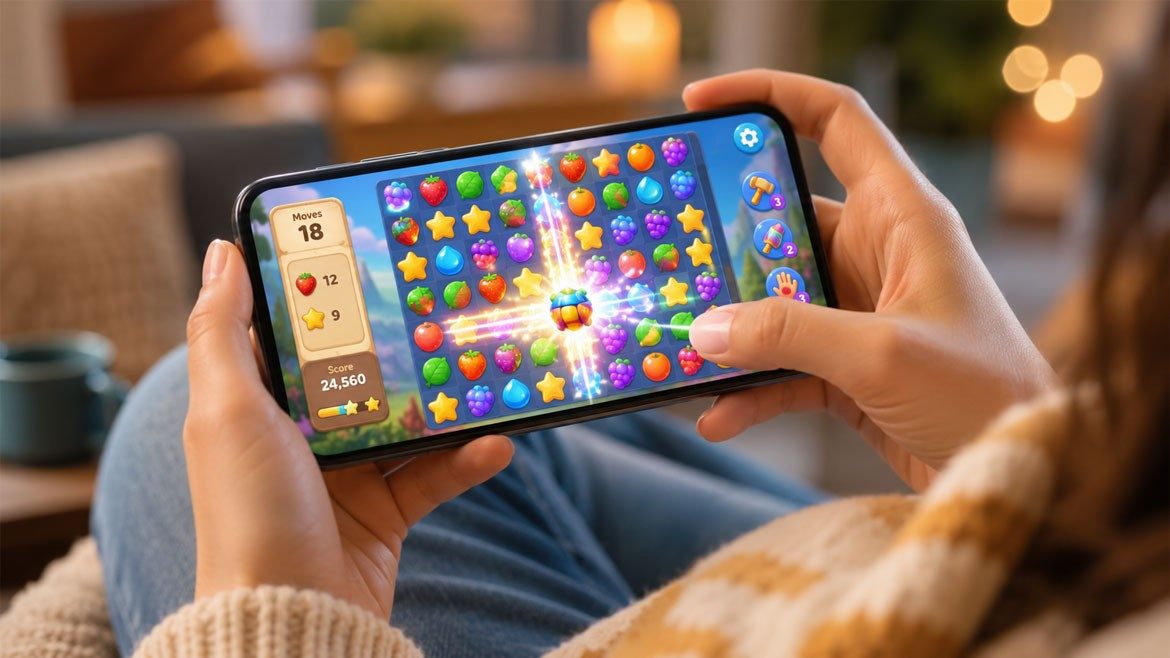
Popular casual games have spent years building experiences around simple mechanics. A puzzle might take only a few minutes to complete, but the game around it can include maps or events that stretch across days. Social casino developers are increasingly applying the same idea. The immediate action stays easy to understand while the wider game gives players something longer to work toward.
The result is a shift in what actually defines the experience. Instead of asking only whether a title uses virtual slots, it becomes more useful to ask what surrounds those slots.
Playtika’s business shows how close the two worlds have become
 Perhaps the strongest evidence comes from publishers that operate on both sides of the supposed divide. Playtika started as one of the major names in free-to-play social gaming. Today its portfolio stretches much further into conventional casual titles.
Its 2025 annual report shows just how significant that shift has become. Casual games generated 70.8% of Playtika’s revenue in 2025 while social casino-themed games accounted for 29.2%.
Picture the Playtika portfolio from a player’s perspective. One person might open Slotomania because of its familiar slot-style format. Another opens Disney Solitaire because of the card mechanic and Disney setting. On the surface, those are clearly different games. Behind them, however, the publisher is working with many of the same free-to-play principles: keeping an established game active and giving players reasons to return over time.
The company is therefore not approaching casual gaming as a side project. It has become the majority of its business.
However, there is one reason not to declare the categories identical just yet. Major publishers still treat social casino as a distinct business. That suggests the industry still sees meaningful differences in the content and audience. Yet a genre can remain distinct while becoming part of a wider gaming culture. Puzzle games and solitaire are different experiences, but both sit comfortably inside the casual gaming conversation. Social casino games may be moving toward a similar position.