
At first glance, Beggar’s Road, which is now available on Steam, looks pretty simple. The map is small, centered around just eight locations in and around Liege in the year 1407, and the overall presentation is fairly modest. But that scale actually makes sense. Some people you meet in the taverns of Beggar’s Road talk about how they are saving up just to make a once in a lifetime trip to a neighboring town, and there are others who have no plans to ever leave at all, which immediately gives the world a grounded medieval feel. Most people in this setting are not globe-trotting adventurers. They are struggling to get by close to home, and your ragged little party fits that perfectly.
Under the surface, though, there is a lot more going on than you might expect.
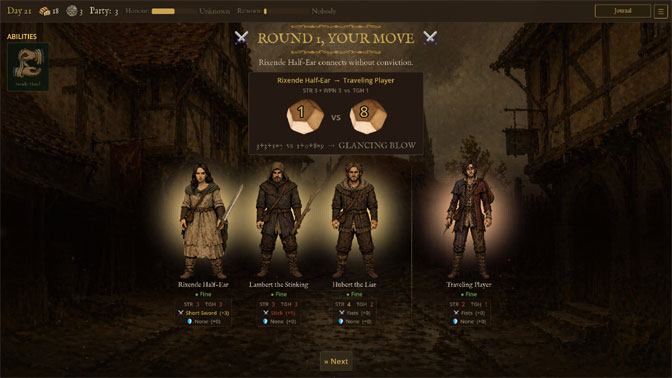
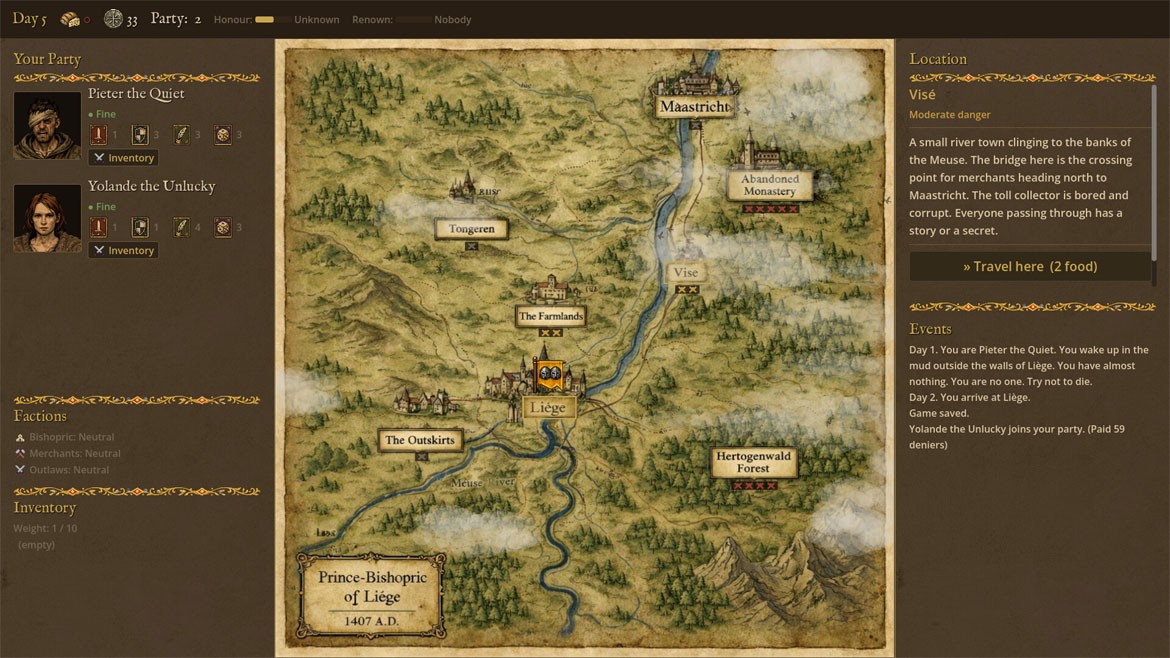 As you move around the countryside and between towns, you run into all kinds of encounters that need to be resolved before you can continue. Some are combat based. These play out with dice rolls, which look to be d12s based on the interface, with both your group and the enemy taking turns swinging away at each other. Combat starts off fairly easy, and for the most part I never felt too pressed by it, though I did lose one early fight while I was still figuring out how everything worked.
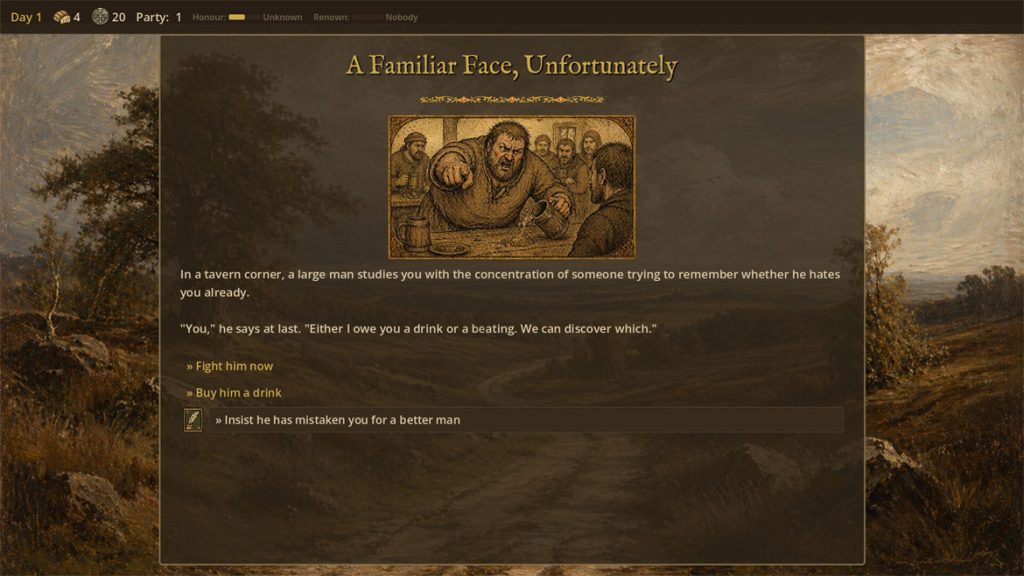
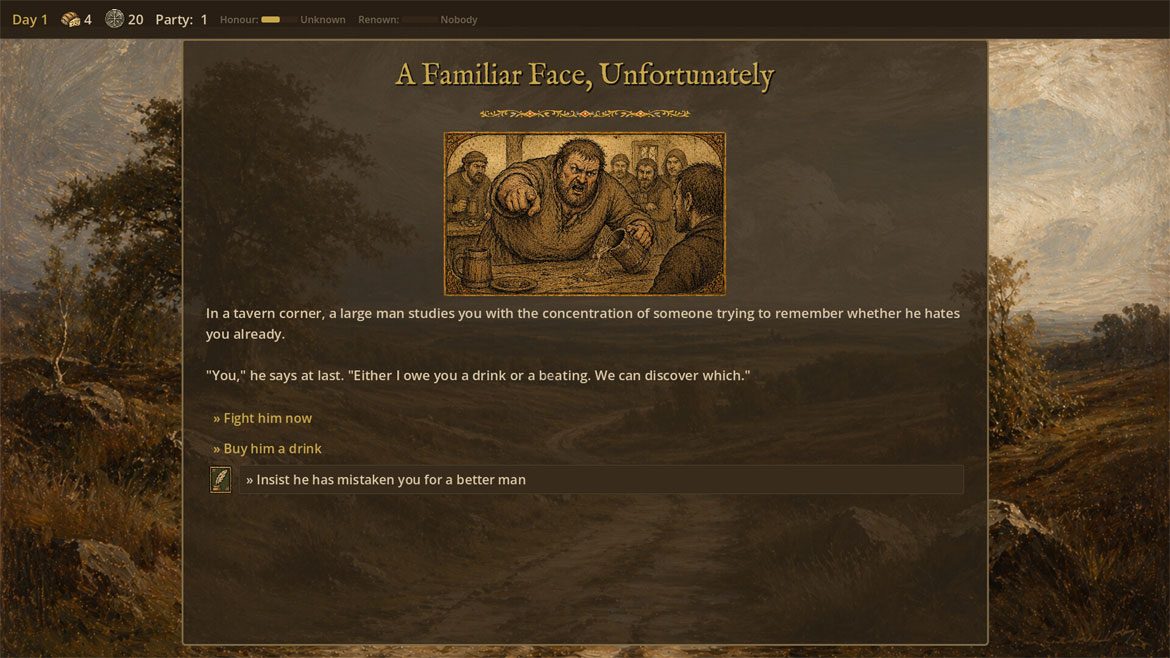
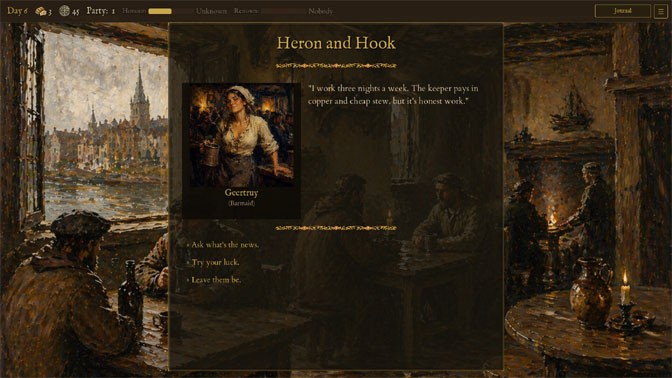
The other type of encounter is where Beggar’s Road really starts to shine. These are story-based scenarios where the game presents you with something dangerous, strange or morally questionable and then asks how you want to respond. Some of the options are funny, and some are practical. Some are outright nasty, like robbing someone who needs help on the road instead of assisting them. Others rely on your skills using background dice rolls with the game simply telling you whether your attempt succeeded. Unlike something like Baldur’s Gate, you do not always see the roll outside of combat, but the skill logic still makes sense. Talking your way out of trouble might hinge on luck, while shoving a cart out of the mud is going to be more about strength.
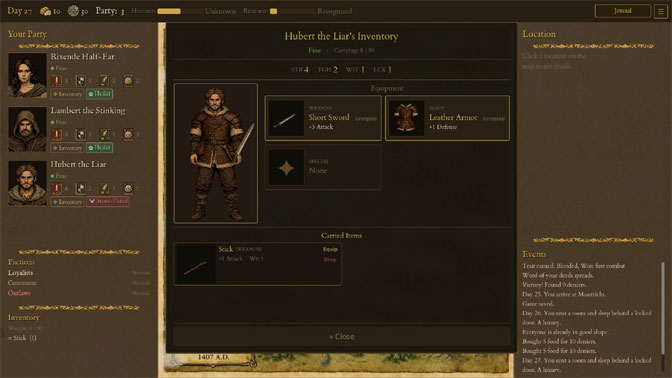 One of the smartest things Beggar’s Road does is refuse to treat you like a chosen hero. You do not create your character. You are handed some random miserable soul, and they are usually weak, shabby and saddled with a less-than-glorious nickname. My first few examples included people with names like Janet the Stinky, Baudouin the One Eye and Lisbeth the Muddy. Occasionally, you will get lucky and roll someone with pretty solid stats, but the whole point is that you begin as a nobody. You are not a knight, a wizard or a legendary mercenary. You are a drifter with a stick, a set of old clothes and no obvious path forward except not starving to death.
The beginning of Beggar’s Road works well. You start in an outskirts camp, doing scavenger work like digging through garbage, battlefield leftovers and whatever else might turn into a few coins at the end of the day. You do not even sell your findings directly. You hand them over to a taskmaster who pays you once your shift is over. At first, that is basically your life.
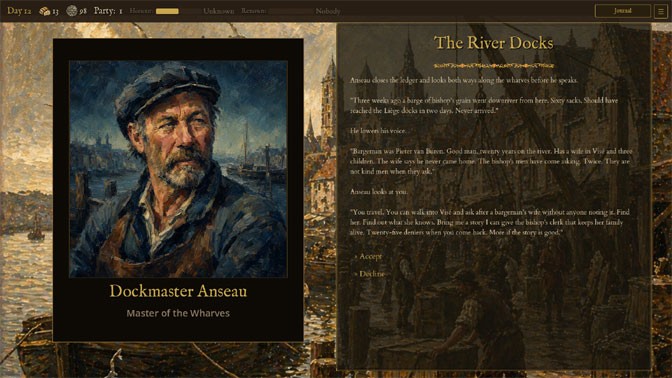 Eventually, you can start heading into Liege itself, which is both the closest major settlement and the largest city in the title’s world. There, things start opening up. You can find other work, whether that means helping out a blacksmith or begging near the cathedral, and more importantly, you begin to learn about the three major factions of Beggar’s Road. The Loyalists follow the bishop who rules the land and are the most powerful group, though they are clearly under pressure. The Commune is made up of merchants and guild interests who oppose the bishop and want him weakened or removed. They are the wealthiest faction. Then there are the Outlaws, who mostly exist to rob everyone else and create chaos wherever possible.
The title never forces you to join a faction, but it becomes very obvious that doing so is one of the easiest ways to earn money, buy food and keep yourself alive. Working for one group will usually damage your standing with the others, especially if you start cozying up to the Outlaws. That said, the system is flexible enough to let you game it a little. I found that buying a round of drinks for a faction’s tavern could raise my standing enough to smooth things over, which I absolutely used to keep the Loyalists from attacking me on the road while I was mostly doing Commune work.
 As your fortunes improve, you can begin recruiting more people into your group, eventually building a party of up to four. Recruitment happens in taverns, and it is a fun little gamble every time. You get to see someone’s basic stats and hiring cost, and the stronger or more specialized people demanding more money. A disgraced knight, for example, is obviously going to cost more than a half-starved peasant. What is odd is that most recruits also seem to come with useful perks, such as healing the party each day or generating Honor while traveling, but you do not get to see those before hiring them. You also cannot fire anyone later, which makes party building feel a little more restrictive than it probably should. Realistically, that means some save scumming may be in order if you want to build the ideal crew, especially because every new recruit also eats a unit of food per day, so your expenses rise quickly.
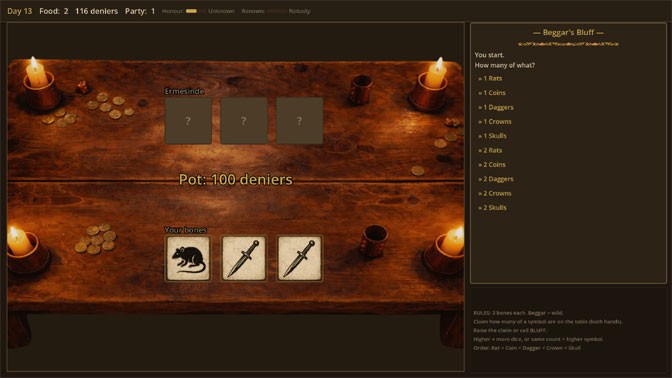
Once you understand the systems, earning money in Beggar’s Road is not all that hard. One of my characters had high Luck, so when money ran low I could usually get by with pickpocketing or even outright robbery, though I mostly tried to stay on the straight and narrow. The real cash fountain, however, turned out to be Liar’s Dice, which is played in every single tavern in the game. I saw some people online claim the minigame was rigged or nearly impossible, but I used to play it all the time in college at a gaming hangout, so I found it very manageable. Before long, I had gone from scraping by in Beggar’s Road to carrying around thousands and thousands of coins just by hopping between taverns and betting the 400-coin maximum. At one point, I probably had more money than the bishop.
 That does reveal one of the title’s balance quirks. There is not actually that much to spend your fortune on. Food is important, of course, and once you have a full party, each of your characters can equip a weapon, armor and one situational item like a torch or bandages. There are also relic-style items like saints’ bones that can boost stats for one person or the whole party. But most of the really interesting accessories come from quests or discoveries rather than shops. The actual equipment economy is pretty shallow. Once all four of your people are decked out in plate mail and quality swords, there is not much left in the world of Beggar’s Road to truly threaten you or even purchase. At that point, the challenge curve flattens out pretty hard.
Even so, there is still something very appealing about the way Beggar’s Road presents itself. The graphics are simple but attractive, and the muted color palette reminded me a lot of Roadwarden (ironically another road based title), even though that game was more traditional in how it handled role-playing and player agency. Beggar’s Road is more compact, more system-driven and a little more mischievous in tone, but it shares that same low-key ability to pull you into a rough, lived-in world.
 In the end, Beggar’s Road is a small RPG that feels larger than it first appears. Its map may be compact and its presentation modest, but there is a lot of storytelling, faction maneuvering and survival strategy packed into that little patch of medieval Belgium. The learning curve is front-loaded, and once you understand how the systems fit together, especially the money side, it becomes pretty easy to break through the early struggle. But even then, the journey stays entertaining thanks to the humor, the atmosphere and the sheer weirdness of the situations that players keep stumbling into. For around five bucks on Steam, with a free demo if you want to try it out, this is an easy title to recommend for anyone looking for a low-key RPG adventure with dark comedy, medieval grit and more depth than its humble first impression suggests.