
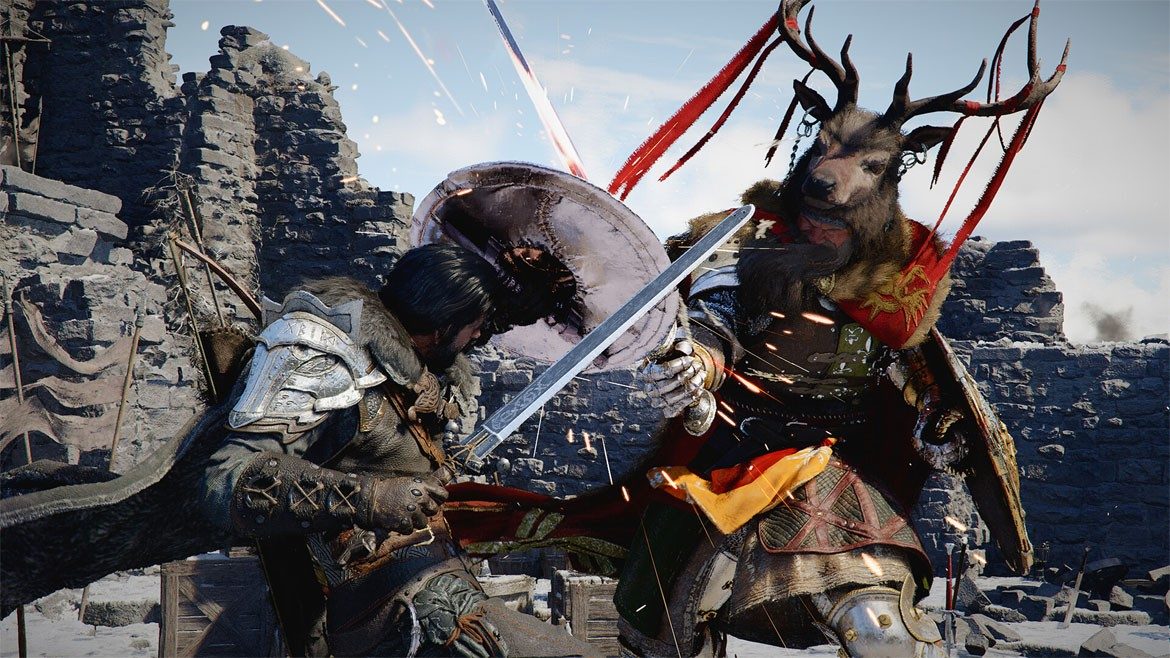
Crimson Desert is one of those special action RPGs that is brazenly ambitious without trying to hide its flaws. This is a game clearly inspired by (in its attempt to take the best elements of) other titles like The Witcher 3, Zelda: Tears of the Kingdom, and a little bit of Monster Hunter thrown into the mix. There is so much to do and so many things for players to interact with and also break, that you can probably spend hundreds of hours not even engaging with the main quest and still find lots more to do. So, is Crimson Desert going to be that game to replace Skyrim for so many players, or is this a game that should be unceremoniously booted off a cliff by a guy in a bear getup? Let’s find out.
Also, if you are looking to get ahead in this very complicated RPG, check out my Save State column with a guide to unlocking four key elemental powers very early in the adventure. I played Crimson Desert on the PC through Steam, but it’s also available for the Xbox Series X and the PlayStation 5.
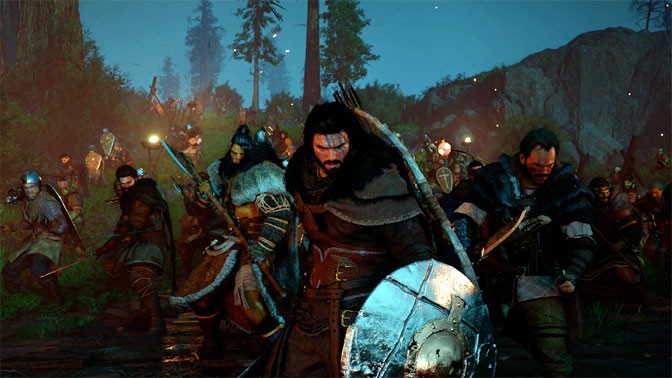 Crimson Desert begins with your protagonist Kliff in a forest, having a meal with his family the Greymanes. Their dinner is quickly disturbed by an invading force that executes Kliff, slitting his throat and kicking him off a cliff (Alanis Morisette would call this ironic) while any surviving Greymanes are scattered all over Pywel. After his seeming death, Kliff awakens sometime later with an obvious scar on his neck, but now he’s packing some supernatural powers to help him get the old gang back together again. Of course, Kliff also encounters a couple of gods who very vaguely give him some directives, but Kliff doesn’t even ask them how he died and came back to life. In fact, there are a lot of questions players may have about the story that Crimson Desert is completely disinterested in answering (but more on the story later).
Kliff’s major motivation throughout Crimson Desert is to find any survivors of the Greymanes and to rebuild his group after the events of the introduction. Story isn’t a major focus of Crimson Desert, as it presents you with seemingly unfocused dialogue that jumps between backstory with the Greymanes and the Abyss. The faction stories you encounter during the side content, however, tend to be quite focused and some are even character-driven to make them interesting, but the main Abyss storyline takes a back seat to flashy boss encounters with the occasional expositing dialogue that Kliff is uninterested in engaging with at any time. For the most part, if you treat Crimson Desert like a fantasy gang war with the occasional supernatural warring gods subplot, you’ll be much happier while exploring your way through Pywel.
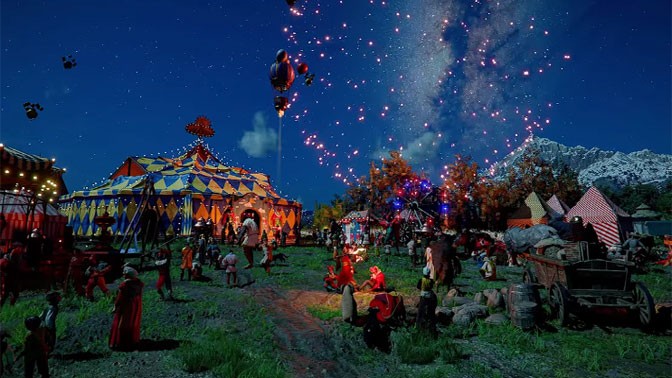
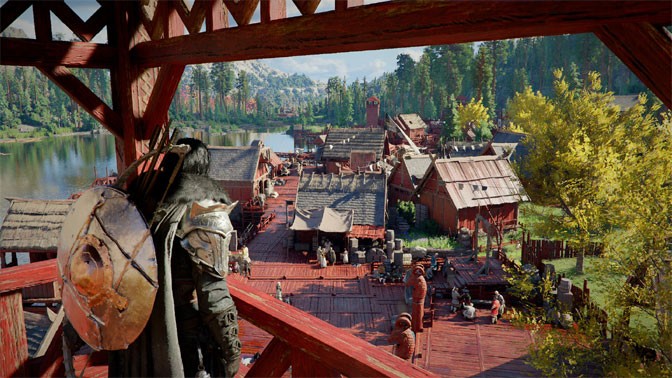
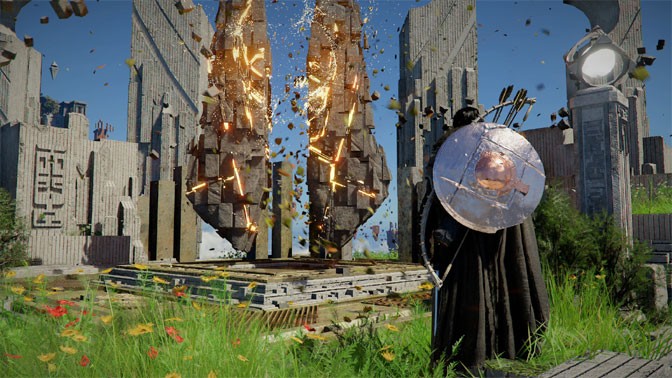 The environments of Crimson Desert are among the most interesting and imaginative out there. Throughout your journey, you’ll encounter lush forests and medieval towns as well as floating cities, high tech civilizations, and dens of monsters. The actual world of Pywel is so incredibly varied and vast that it’s always a pleasure to explore, slap around enemies, solve puzzles, and loot around every possible corner. The combat is intensely fleshed out, giving the player more options than I’ve seen in most other action RPGs, and big, flashy bosses that will require you do a lot more than mash buttons to defeat.
Combat in Crimson Desert is a complete treat. You have access to a wide variety of weapons, such as a sword and shield, spear, a two-handed great sword, dual blades, and even the ability to punch your enemies in the face if that’s what you choose. As you explore, you’ll encounter Abyss Artifacts that you can spend in your skill tree to enhance options available to you, so while you may start off a relatively weak striker, after upgrading some of your options you’ll be able to punch, grapple, and even disarm whatever foes are unlucky enough to encounter you in Crimson Desert.
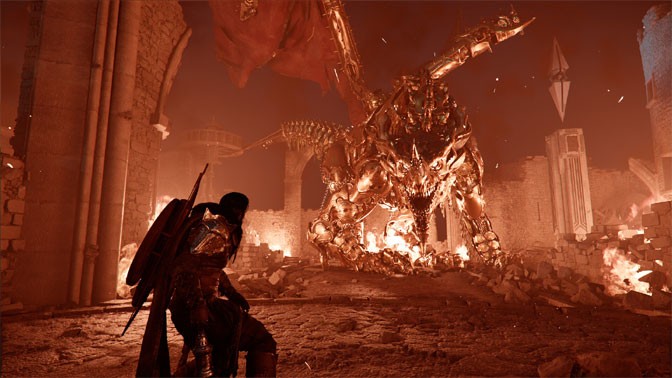
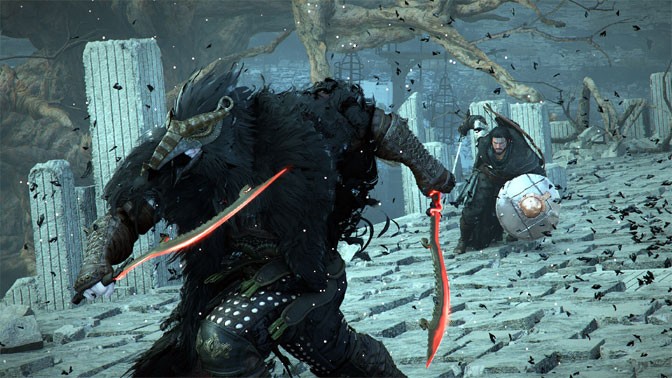 For defensive options, you have access to a dodge, a parry, and copious amounts of prepared food that you can eat to recover health. Most regular enemy encounters are no big deal, but the boss fights in Crimson Desert are pretty theatrical and demand a lot more from the player, and one particular boss named Ludvig is a pretty spectacular highlight of both the combat system and how Crimson Desert wants you to use every tool at your disposal. I found some combat mechanics, like Nature’s Snare, much easier to perform on mouse and keyboard compared to using a controller, so bear in mind that some techniques may be more easily utilized depending on which control scheme you choose.
The actual list of actions Kliff can perform, however, is practically labyrinthine. You get basic traversal and puzzle solving abilities, like the power to glide like a crow or use a grappling hook to climb, force palm to push objects and foes, plus plenty of other techniques. As you progress through the story chapters exploring and finding more ways to enhance your abilities, you’ll eventually be able to pick up pillars that break in boss arenas, lift them up, and slam them into bosses for massive damage, most easily utilized by using your Focus to slow down time to capitalize on an enemy’s opening. There are probably 20 or more different techniques you can fire off at any given time, including sweeps, throws, lunges, kicks, and slams. You have access to a wide variety of moves that help you make the experience your own, and that’s not even getting into the various elemental powers you’ll encounter too.
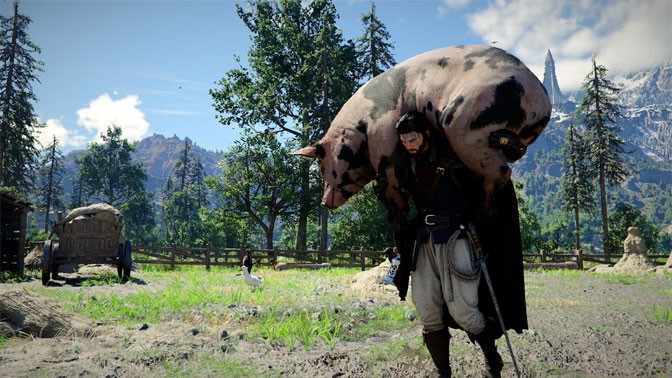 If you enjoy side activities to your exploration and questing, Crimson Desert has subsystems on top of subsystems, perfect for helping you absolutely lose yourself like you’re Eminem in the Lost Woods. You can journey across the land and capture bounties, find artifacts that will grant you skill points, spend your days as a rancher and farmer, trade packaged goods that can have wildly varying prices, build trust with NPCs and even hire them to do missions for you to earn a large variety of rewards, and get disproportionately interested in gambling. There’s base building, wearing a mask and stealing items, and so, so much stuff to do in Crimson Desert on top of the exploration, combat, and puzzle solving. This is legitimately one of the densest and deepest titles I’ve ever played because you can play for dozens of hours and not even know how to interact with some of these systems.
The trading system coincides directly with the base building, as once you get enough people into your camp, you’ll be able to pack up goods and trade them using a wagon cart you now have access to. You then drive said wagon to a trading post, but you’ll need to make sure you’re monitoring what the traders there are buying because you don’t want to weigh down your cart with goods your destination isn’t even buying. You can quickly see what items can be sold for profit or for a loss and even encounter a trader who will buy items at an insanely profitable margin, but the trader will only buy one item on a given day, so it’s good to keep an eye out on these kinds of things in between your other quests if you want a lot of supplies for your camp. Of course, if your wagon breaks down partway due to damage or other factors, that could lead to you losing every item in it which can be a pretty massive loss.
 Crimson Desert is incredibly hands off in its moment-to-moment gameplay, allowing you to rush the story and side missions if you choose, but you could literally spend dozens, and maybe even hundreds of hours interacting with all of the little extra systems and subsystems that are on offer. Some of the systems are intertwined, such as calves or baby goats only becoming available for ranching if you build up enough trust with specific NPCs, you can get seed supply contracts by increasing trust with various grocers throughout Pywel, you might get special items or expansions to these side mechanics from sub quests, and there’s just so, so much that goes into all of these various systems. But most of those are probably outside the scope of a review. Being honest, if you like getting distracted for hours by various extra systems in video games, Crimson Desert has your back on that front and then some.
Most everything encountered in Crimson Desert will have a tutorial that will explain how to perform an action or complete a mini game, but sometimes those tutorials are a little, well, wacky. This is a nonlinear open world game, and by exploring you can wander around and find tutorials for abilities that are necessary for a story mission in chapter 4, but you can accidentally stumble across said tutorial in chapter 2. As far as I know, the tutorials don’t seem to repeat if they are reached when the story intends for you to find them to activate a button or switch. This led to me forgetting about that technique by the time chapter 4 came by and required me to use it, which meant a quick internet search was required to remember it.
 The important thing about Crimson Desert is the moment to moment gameplay, and the bottom line is that if you enjoyed other open world ones like Zelda: Breath of the Wild, or games with incredibly large maps that let you build a character such as Skyrim, you will very likely enjoy Crimson Desert too. If you’re a story-first kind of player who needs to be given a story motivation, then the entire Abyss storyline in Crimson Desert will very likely leave you wanting, even if the tale of the Greymanes is perfectly serviceable. This does make a good time to speak on Crimson Desert’s shortcomings involving its story, however.
What’s most astounding about Crimson Desert is that it absolutely has a story, but the vast majority of information that players want to make sense of regarding the plot lies in a completely optional area near the end of the adventure. This, unfortunately, means that I found the actual story presentation of Crimson Desert awful. To explain, while you’ll encounter bosses who will exposit fairly regularly throughout the game, not much of it is presented in a way that will help you make sense of what you’re hearing, hence why many have said Crimson Desert’s story is bad. Partway through Crimson Desert you’ll find a place with a variety of puzzles, but there’s a completely optional location on the third floor, which you have to randomly decide to grapple up to since it has no ladder that contains all of the story content the developers just…didn’t put into the dialogue or cutscenes.
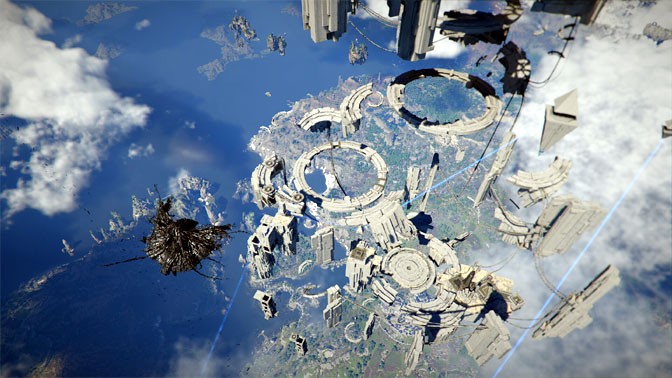 After beating Crimson Desert and solving 40 Abyss puzzles, you can find some lore books on that third floor which explain why Kliff has a subdued personality, why he never questions that he straight up died in the prologue, and also informs the player that Crimson Desert has more in common with something like Dragon’s Dogma than it does Breath of the Wild. It’s ultimately a very cool reveal, but it’s incredibly annoying that the most important element of the Abyss story that takes up so much of the title is hidden away in such a manner that it’s incredibly easy to miss. The reason why I find the choice to hide away the game’s core story elements is due to the fact that these lore books dramatically enhance the tale of Crimson Desert, with it only being vaguely referenced here or there in dialogue throughout the story.
A prime example of tell, don’t show: The story details are tucked away in a lore dump like this is Xenogears’s second disc, where Fei is reading a book in a chair. It almost seems like Pearl Abyss tried to do a Souls-style story/lore synergy, but the problem with how Crimson Desert implements this is that it forces you to sit through entirely too much dialogue throughout this to not adequately explain anything unless you find random books after beating the game and doing puzzle challenges. So, while there are absolutely some story elements in Crimson Desert that will blow you away, it almost seems like the developers were satisfied actively hiding information that helps the player make sense of almost all the dialogue players would have heard from enemies throughout the adventure, which is a strange choice. So, if story is important to you as a gamer, Crimson Desert will likely leave something to be desired, but thankfully it makes up for it in every category with its incredible gameplay, world design, and boss encounters.
 There are other characters you can play as through your journey in Crimson Desert, and you’ll unlock companions such as Damiane, whom you get relatively early around chapters three or four. You can play as these companions, but there didn’t seem to be a whole lot of reason to do that, since you’d be regularly interrupted by “THIS IS KLIFF’S STORY” nigh constantly when doing quests of any variety. You can invest skill points into your companions to unlock skills, but there are many puzzles that can only be solved with Kliff due to the companion lacking his gauntlet or bow, and many optional bosses, even ones that actually have nothing to do with Kliff, require you to play as Kliff to fight them, though this may be patched in the future. You can summon the companions to come with you as you journey to take down enemy strongholds, which worked perfectly fine.
Controller support on PC does have some issues, however, though the problems are somewhat strange to explain. In my instance, during the beginning tutorial sprint was permanently toggled on- as in I was just constantly running and consuming stamina even if I let go of the analog stick. This would have actually rendered the game completely unplayable if it weren’t for the fact that I was able to look up that most controller issues were from Crimson Desert’s recent patch, of which the fix was to press the shift key on the keyboard. That’s correct – to fix the controls when using a controller, I had to press shift on my keyboard and that magically fixed everything, and I was able to control Kliff again. Crimson Desert makes for a great third person RPG experience but a terrible auto runner game. The good news is that controller support issues were typically quashed (or new problems introduced) in the many patches that Pearl Abyss have released for Crimson Desert over its post-release cycle.
It practically sets the bar for post-launch update support, however, with something new coming to Crimson Desert on almost a weekly basis since release. This includes follower behavior, boss rematches, allowing players to use their companions more often, additional mounts, and many, many more. The developers have addressed player concerns quickly, turning this almost into a live service single player RPG, but it has all the benefits of not asking for any more cash from the player, which is always appreciated. Pearl Abyss has gone out of its way to add more things to do in Pywel while quashing bugs and glitches that may have caused players grief previously, and it should always be lauded when developers give their titles plenty of support.
Crimson Desert is an absolutely fascinating adventure. It’s easy to get lost while exploring Pywel, but you’ll always be discovering new things at a relatively constant rate. You can build Kliff’s abilities in a way that appeals most to you and can respec at any time you feel something may not be working out well, which is super valuable when the game has as many techniques as Crimson Desert makes available to the player. While the story left a lot to be desired from a storytelling perspective, the incredible boss fights, mobs to fight, and set pieces to explore more than made up for any pitfalls its story may have experienced. There are loads of techniques to be unlocked and used, gear to find and equip, and quest givers to knock over into cow dung.
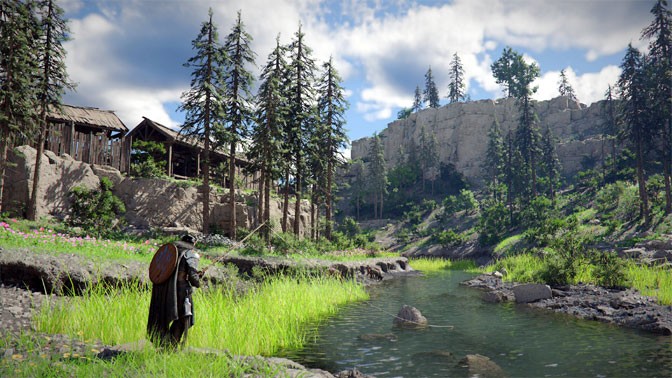 Overall, Crimson Desert is one of the most thorough and magical medieval action RPGs out there, with plenty for the player to do and see throughout its gigantic world. Exploring, fighting, and questing makes up the bulk of what players will do in this game, and thankfully almost all of those activities will reward you with Abyss Artifacts that can be used to enhance your abilities. On top of exploration and combat being a joy, you can spend your time as a day trader, a gambler, rancher, farmer, and more. This is legitimately one of those titles where everyone brought an idea for a mechanic to the pitch meeting, and when someone asked which of these features to include into the game, the director just said, “Yes.” So, if you enjoy a less story-focused experience with tons to do, Crimson Desert will definitely get your money’s worth!