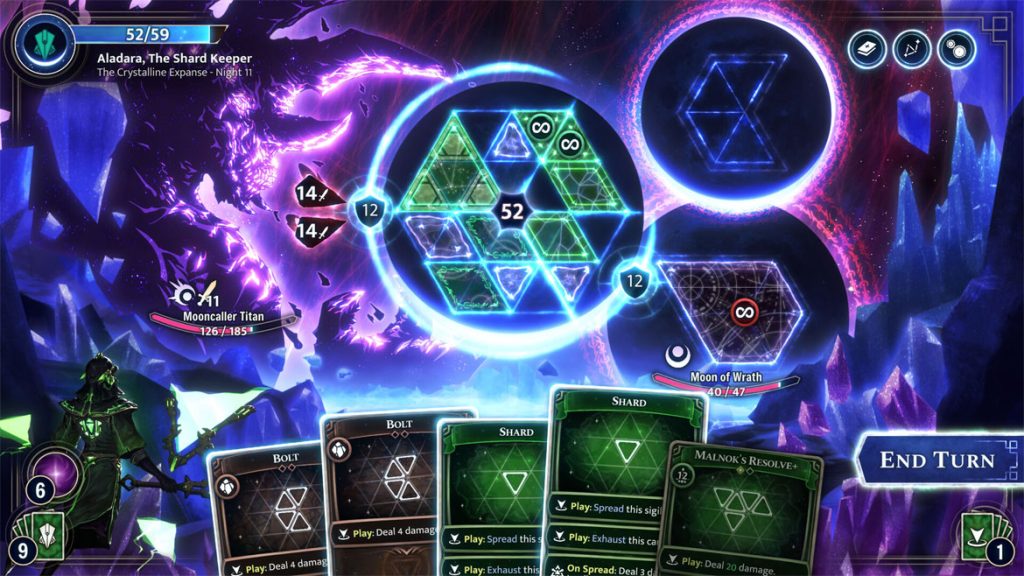

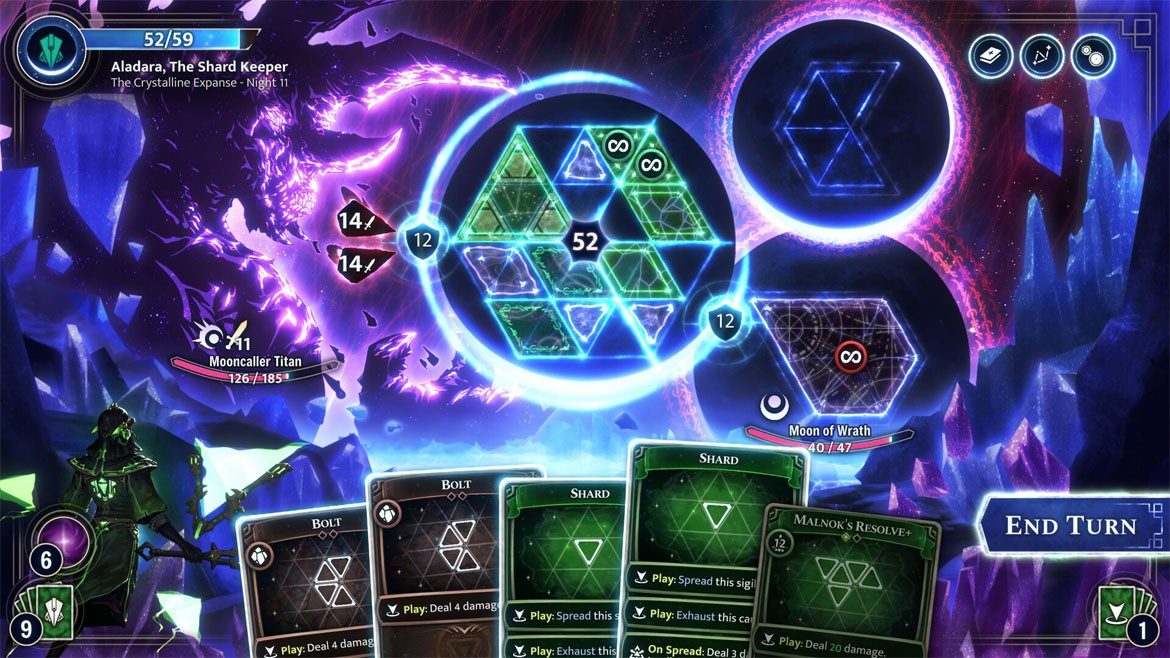
Moonsigil Atlas is a roguelike deckbuilder developed by Snake Tower Games in which your mission is to free a mysterious dark entity by traveling across the moons with the power of geometric shapes called sigils and astral-beast-slaying abilities.
 The title takes a unique approach to the roguelike card genre because it doesn’t use a traditional mana system compared with many other deckbuilders. Instead, it tests your ability to adapt and figure out how to fit your sigils into different hexagonal patterns. Moonsigil Atlas features three playable characters with various build options and more than 250 cards to collect and use. Playstyles can range from damage over time to board-filling card-control combos to big multiplicative damage. It is available on Steam for $19.99 and supports Steam Deck and full controller play.
The narrative and storytelling that Moonsigil Atlas uses to explain its world are unique. The writing leans into atmosphere and ambience, explaining the universe around you instead of relying heavily on cutscenes or dialogue. You play as one of three warlocks chosen to slay three astral titans and other smaller astral beings to free the dark entity aiding you on your journey. One issue with this approach is that you never learn much about the different warlocks’ backstories, or why you are playing as them in the first place. Even so, the gameplay variety among the three characters still feels fun.
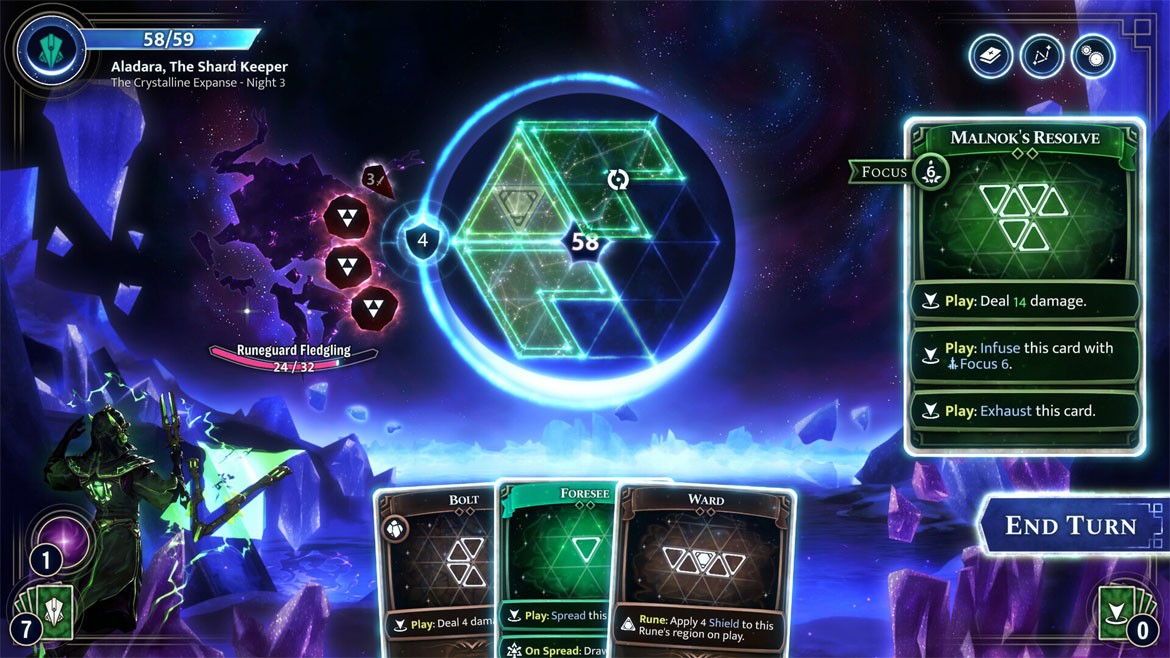 The first wizard you play as is Feldryn, who specializes in having a large amount of card draw and buffing cards with heavy-hitting sigils, sometimes even multiplying their damage. The second character is a caster named Aladara. She specializes in filling up the board with sigils or using exhaust-based builds. Both approaches can create some of the easiest infinite combos among the characters if you can grab card draw during your run. The cost is that you have to manage your deck and board space more carefully because once a card is exhausted, it is gone for the rest of that combat encounter unless you have a way to regenerate it.
The last playable character is a high-risk, high-reward pyromancer named Tark-Thul. His main playstyle involves playing ash sigils that linger on the board and can be comboed with ashen sigils that replace them. That does not mean this is his only archetype, as he also has viable single-tile sigil builds and damage-over-time options. The high-risk, high-reward part comes into play because many of the sigils that enable his main playstyle tend to be larger, which creates more spatial packing problems.
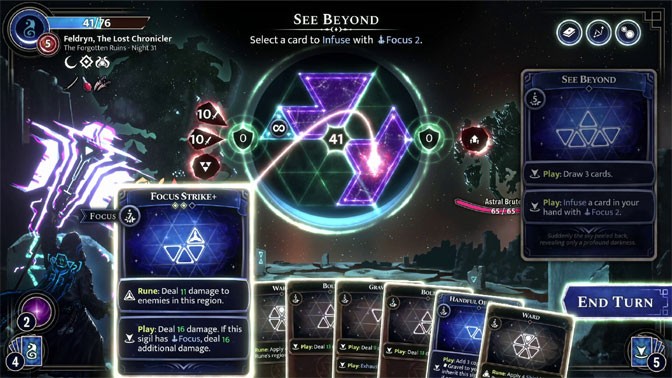
 The tutorial and control system are quick and minimal when you first load into Moonsigil Atlas. The controls can genuinely be handled with one hand and small mouse inputs, which makes the title easy to approach. The sigil and moon grid system is where the strategy comes in. The different sigils featured on the cards have diverse shapes, and you have to figure out how to maximize board space while opposing units place obstacles on your board and force you to work around those obstructions.
While the gameplay is distinctive, this type of spatial cognition usually appeals to a more niche audience. Still, the accessibility of the controls and card play makes the system easy to grasp. It does not feel as complex as some other spatial packing titles, at least once you start to understand how the sigils fit together.
 There are also different keywords attached to sigils in your deck. One example is eternal, which makes your sigils or an opponent’s sigils last on the board until the end of combat. Eternal sigils cannot be removed except by a few select cards. The upside is that they typically have buffs that last throughout combat, so you have to play around them while also using them to support your larger strategy. There are many more keywords to learn too, and they help create variety while giving players more combinations to discover.
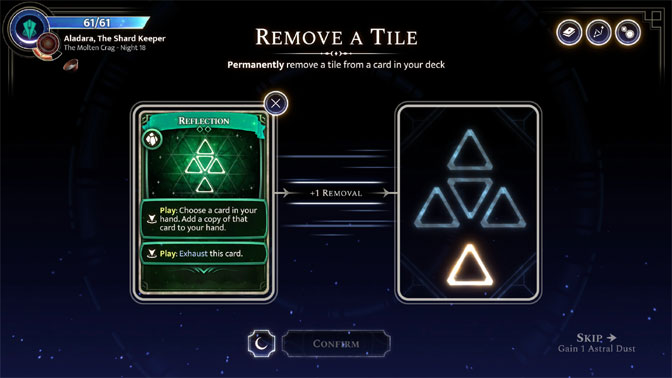
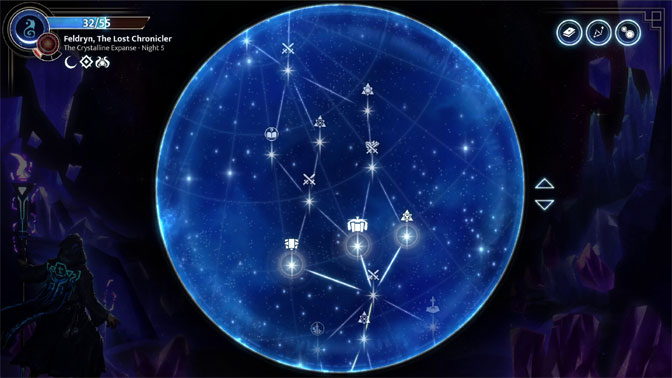
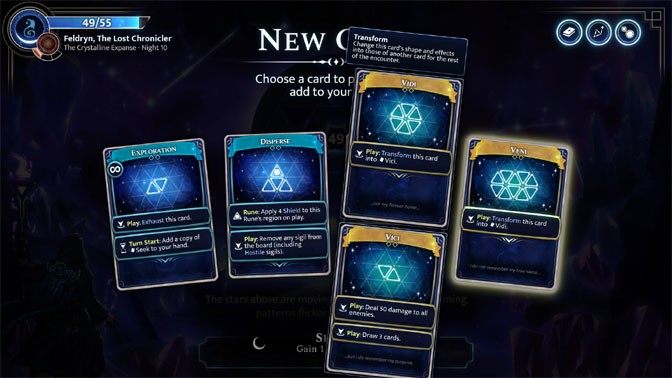
Progression in Moonsigil Atlas is reminiscent of other popular roguelike deckbuilders like Slay the Spire or Legends of Runeterra’s PvE mode, where you have different options for shaping your deck outside of combat. You can get rid of a card that doesn’t synergize with your deck or remove certain tiles on your sigils so they fit on the board more comfortably. The choice is yours.
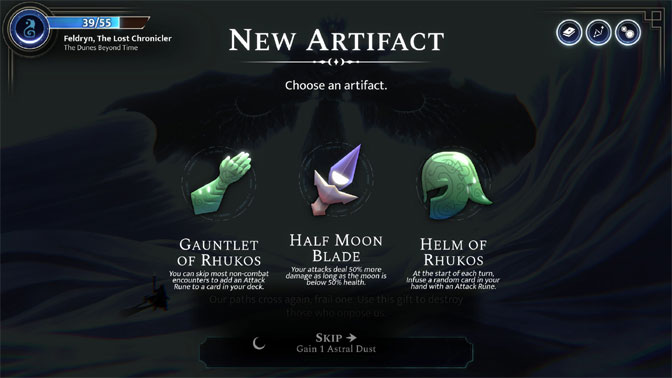
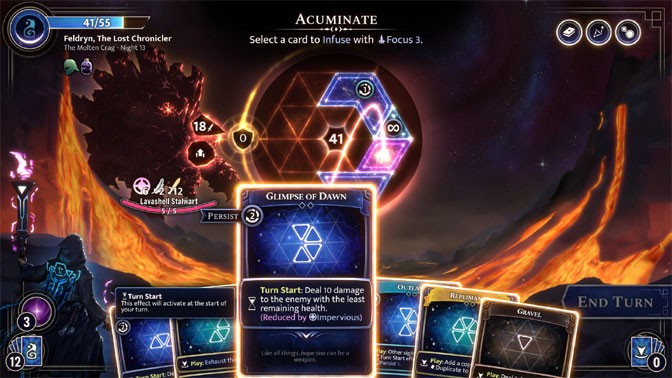 There is also a collectible called astral gems, which are rarer to come across. You earn them by beating specific combat encounters or by skipping three out-of-combat rewards. Astral gems allow you to get extra benefits from rewards, such as cutting two cards from your deck instead of one or removing one extra tile from your sigils. You can also obtain forbidden artifacts that act as outside buffs to your deck, though coming across these artifacts is rare. You might only run into two or three of them in a run.
Don’t get me wrong, artifacts are fun, and some of them can greatly boost a run. But many of them don’t feel quite worth the decision compared with directly strengthening your deck archetype. The selection of artifacts is random, which is not inherently negative, but because some of them feel underwhelming, that randomness can occasionally be disappointing.
 Another core mechanic that relates to both combat and out-of-combat planning is the defense system. Every deck has cards with defense tiles that allow you to block incoming damage, and you can also collect cards with multiple defense tiles. Every combat encounter has a specific tile range, and only defense tiles placed within that range will work. If you place them outside that range, they will not work unless a card says otherwise. This also applies to attack tiles, which work in the same general way but deal damage instead of blocking it.
The common enemy variety in Moonsigil Atlas feels diverse enough that every run does not feel the same. You encounter different celestials each playthrough, and their gimmicks feel distinct from one another. Some place eternal sigils, some attack with multiple celestials and some require you to avoid certain tiles so you don’t accidentally buff the enemy. There are also elite combat encounters that reward astral gems. Those fights are harder than common encounters, but they do feel worth completing once you beat them.
 The title features three sections, and each one has a boss that feels unique and tests your deckbuilding choices. One critique is that while the common and elite enemies feel great, the section bosses always remain the same. That makes sense from a story perspective, but in practice it can make later runs feel a little too familiar because you know the general plan for each act’s boss even if your deck is different. Adding even one extra boss to each act that could rotate in would tremendously improve the experience and help runs feel less predictable.
The audio and visuals are serviceable, though there are a couple of quirks. Starting with the visuals, the art style is very pretty, with its astral projections resembling real-life constellations. Some combat encounters also have themes tied to those constellations, which helps the world feel distinctive.
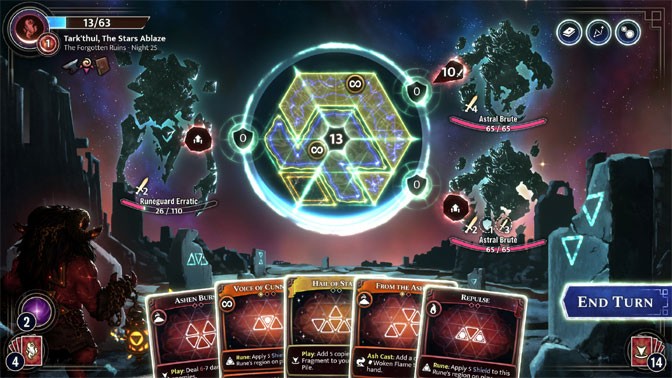 The visual issue comes down to the cards themselves. Because the cards show their sigils in place, they can start to blend together since every shape is made up of triangles. That means you often have to read through the cards until you recognize them, which takes longer than in some other deckbuilders because there is not always an instant visual distinction beyond rarity.
The music is good and gives each section an ambient track that is not overbearing. That works well because Moonsigil Atlas asks you to focus on strategy, board space and card interactions. The soundtrack supports that without distracting from it.
For system mechanics, the title includes a glossary of all the cards and artifacts, which lets players go back and see what they have discovered. That adds a nice collection element for anyone interested in completing that side of the experience.
 My biggest complaint with the system mechanics is the missing surrender button. Whenever I had a run that was not synergizing and I knew the combat was basically over, I had to sit there and accept my fate until the encounter ended. That frustration could have been mitigated with a restart button of some kind. I understand that restart scumming is a common strategy in titles like this, so maybe a restart option after the first couple combat encounters would be a fair compromise.
There is a save and quit option, which lets you stop and come back where you left off. Be careful in combat, though, because the title won’t save your exact spot and you will have to restart the entire encounter. That does mean if you believe you can win and just need to play the fight better, you can always close the title and restart that combat encounter with a new approach in mind.
 In conclusion, while the mechanics can seem overbearing for a new player looking to try out a mana-free deckbuilder, the flow becomes smooth once you put everything into practice. If you enjoy the niche appeal of spatial cognition and making shapes fit together, it is very easy to invest hours into Moonsigil Atlas because every run gives you a different deck and a new set of choices.
The community also has a Discord and Reddit, which lets players connect with other fans and the developers while figuring out card combinations they might never have considered on their own.
With smart spatial mechanics, strong deckbuilding features and beautiful backdrops that keep the adventure immersive, Moonsigil Atlas is a standout entry in the deckbuilder genre. Anyone interested in mana-free card play, tactical puzzle solving or roguelike deckbuilding should consider giving it a shot.