
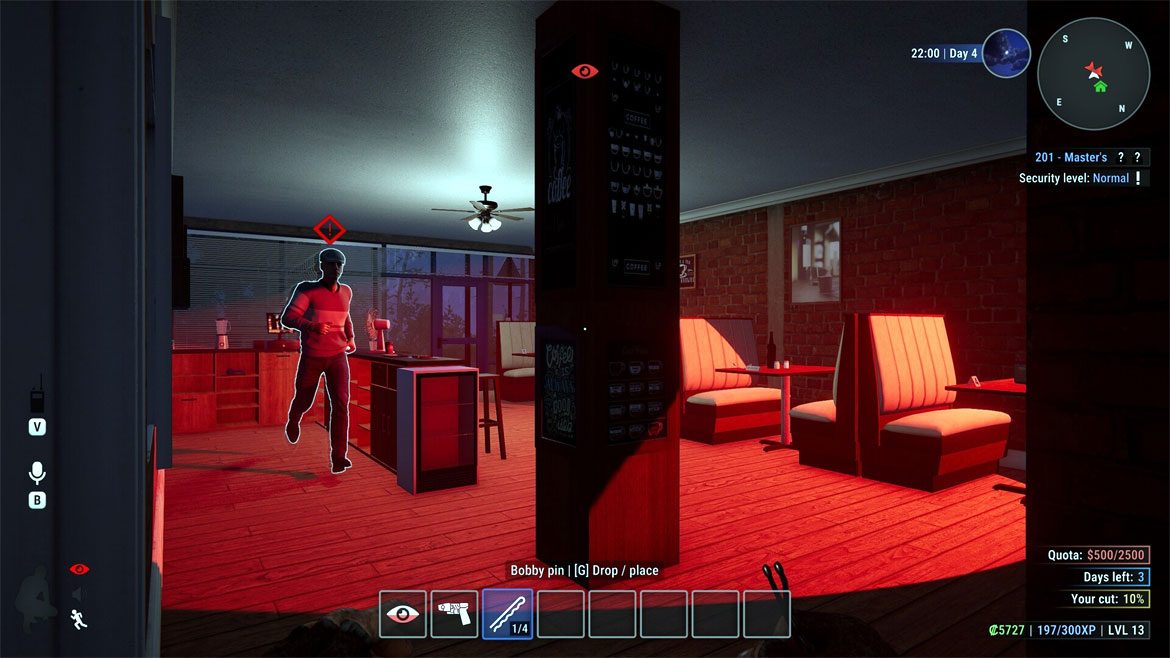
Everyone who reads my Fresh Look column knows that I am a big fan of odd simulator games. I am still waiting for the release of Gate Guard Simulator with bated breath. In the meantime, I picked up Crime Simulator as a placeholder since it was recently ported to the PlayStation 5. Its premise is simple enough: a mysterious person bails you out of jail, and you have to commit a string of burglaries to pay them back.
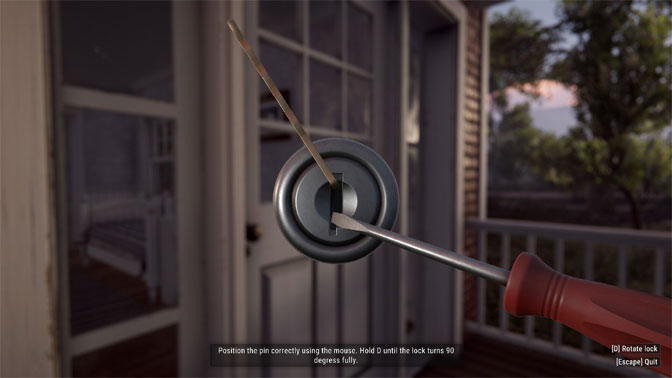 Crime Simulator opens with a short tutorial that teaches some of the basic systems, including lockpicking. That part actually works pretty well. It reminded me a bit of the lockpicking minigames in Oblivion and Skyrim, where you adjust the angle of the pick and try to find the right spot before turning the lock. A lot of the controls are straightforward enough that learning the basics is not especially stressful. At first, I was genuinely excited to settle into a fake life of crime in Crime Simulator. Afterall, the game on Steam for the PC was highly successful with many positive reviews. So, I was looking forward to jumping in as it moved to consoles, specifically for the PlayStation 5. It’s also available for the Xbox Series X and Nintendo Switch 2.
 Unfortunately, my early bout of rapid curiosity did not last.
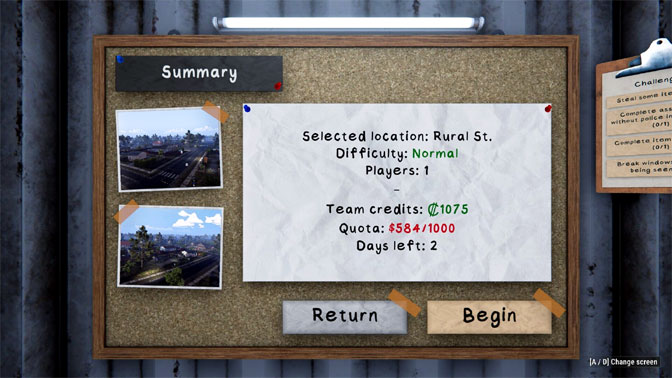
One of the first things that frustrated me was the timer. Crime Simulator is built around players repaying their debt within a limited number of in-game days, and the title makes that pressure clear almost immediately. To be fair, the developers are upfront that this is supposed to be a fast-paced roguelite crime game rather than a slower stealth simulator, so the timer is part of the intended design.
Even so, I found that structure worked against the fantasy I wanted from it. Instead of planning carefully, learning routines, and picking the right moment to move, I often felt pushed into rushing through situations that would have been more enjoyable with a little more breathing room. If you are like me, then a title like Thief Simulator with its emphasis on stealth and careful planning is probably a better choice for enjoying some virtual crime.
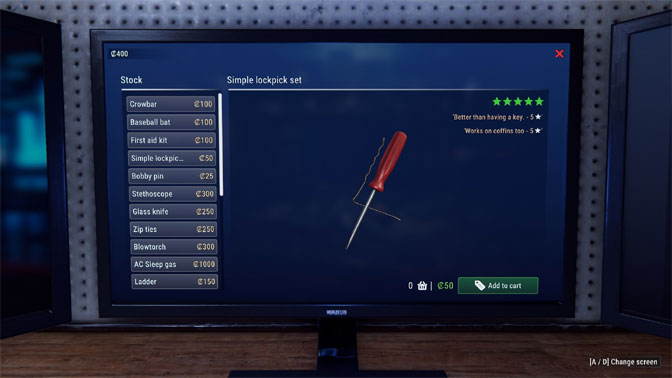 That pressure might have been easier to accept if Crime Simulator felt smoother in practice, but I ran into a few problems that made the experience harder to enjoy. At one point, ordered items were supposed to be delivered by drone, but at least one of them either never appeared properly or was so difficult to locate that I spent far too long wandering around searching for it. It does not do much to help you find those dropped items either. They only show up as a white dot when you are close and looking almost directly at them, which turns what should be a simple pickup into a minor scavenger hunt for the wrong reasons.
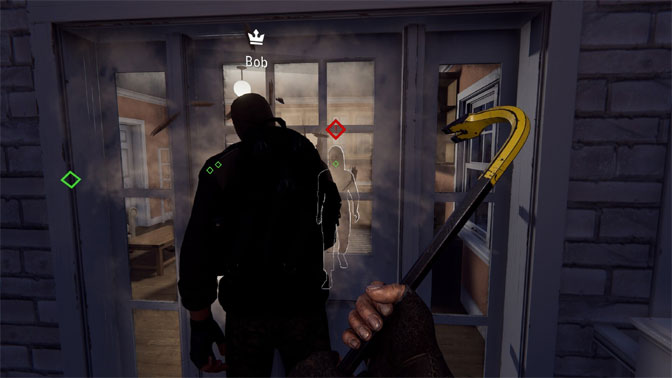
Crime Simulator also punishes early mistakes harshly. If you get caught by the police in those first few days, you lose the night and owe even more money. That makes experimentation feel risky in a way that is more frustrating than exciting. Instead of it encouraging careful stealth, it often nudged me toward blunt solutions just to keep moving. And while the baseball bat is certainly one way to solve problems, I would have preferred a simulator that better supported sneaking and planning over simply bonking my way out of trouble.
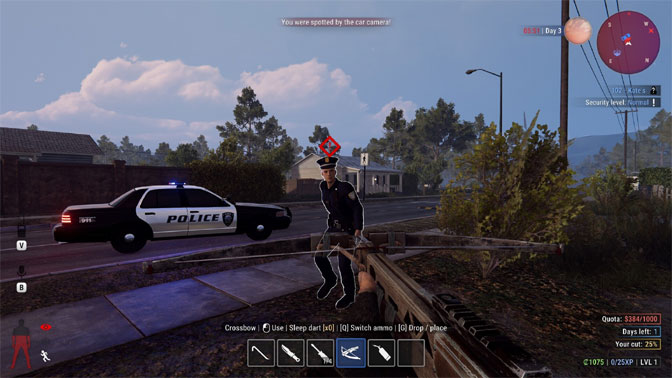 That is probably where Crime Simulator and I diverged the most. It gives you a decent set of tools, and the official feature list mentions lockpicks, sleeping gas, scanners, drones, and other gadgets meant to support different approaches. On paper, that sounds promising. In practice, at least on the console and while playing solo, everything felt slower and clunkier than I wanted. Instead of feeling smart and cunning, I often just felt awkward. The systems never really clicked into the kind of satisfying rhythm that a simulator like this needs.
I can see how the co-op angle might help. Crime Simulator supports up to four players, and a game like this probably benefits a lot from having other people distract residents, scout ahead, or simply make the chaos more entertaining. I played it solo, and in that context the experience felt flat. If you have a full group of friends willing to treat it like a goofy co-op night, you may get more mileage out of it than I did. But as a single-player experience, it never found the spark I was hoping for.
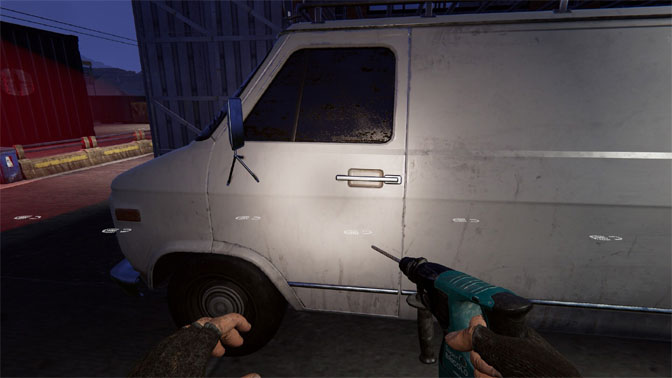
 The presentation is serviceable but not memorable. The graphics and audio are about what I would expect from a mid-tier simulator. Nothing looks terrible, but nothing really stands out either. It has the same kind of functional style you see in a lot of these simulation titles, where the focus is on getting the systems in place rather than creating a world dripping with personality. That is fine when the gameplay loop is strong enough to carry everything else. Here, it is not.
In the end, Crime Simulator feels like a title with a decent premise and a few interesting ideas that never really develop in a satisfying way.
 Crime Simulator’s basic concept of paying off a mysterious debt through burglary is solid, and I can understand why some players might enjoy the co-op chaos or the constant pressure of its roguelite structure. But for me, the clunky pacing, frustrating bugs, and lack of satisfying stealth or planning made the whole experience more tiring than fun.
Hardcore simulator fans may still want to kick the tires and see if Crime Simulator clicks for them, especially with friends. Everyone else can probably skip this one without feeling like they missed much.